

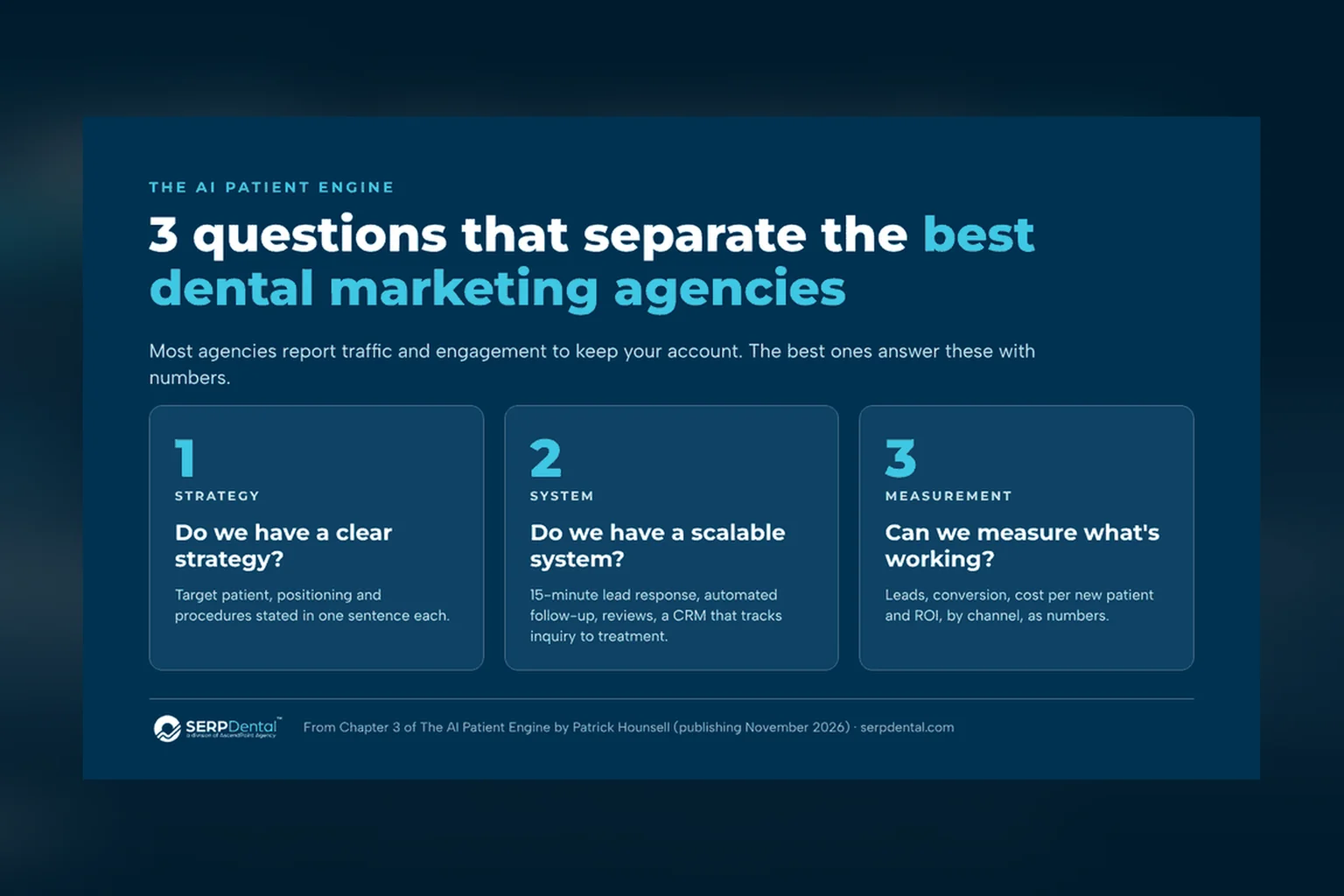
The best dental marketing agency is the one that can answer three questions with numbers: do we have a clear strategy, do we have a scalable system, and can we measure what's working? Most agencies optimize for their own retention, with traffic and engagement reports, not for your production.
I've spent more than thirty years inside marketing agencies, and today I run one that works only with dentists, so I am hardly a neutral judge. That is why this guide hands you the criteria instead of a ranking. Apply them to every agency you talk to, including mine.
Key takeaways
- The best dental marketing agency is the one that can answer three questions with numbers: strategy, system and measurement.
- A good agency can show you a one-page strategy naming your target patient, positioning and procedures before it spends a dollar.
- More than two "no" answers to the five system questions means there is no system, and no amount of ad spend will fix that.
- Ask for leads, conversion rate, cost per new patient and ROI by channel; "we'll look at traffic trends" is not measurement.
- Score every agency, your current one included, on a twelve-point scorecard and read it by group: fewer than three points in any group means that gap is open.
Why "best dental marketing agency" is the wrong search (and what to ask instead)
Retire the question "who is the best?" and ask "who can close my gaps?" An agency can be brilliant at paid search and still be wrong for you. The three fatal gaps are no strategy, no system and no measurement, and each one becomes a question you can ask across the table.
A couple of years ago a practice owner in Phoenix called me, borderline angry. She had spent $180,000 on marketing in eighteen months across three agencies: Google Ads, Facebook Ads, SEO, social media, everything they told her to do. What she had to show for it was a stack of fifty-page PDFs, a website that looked nice and did nothing, and maybe ten new patients she could trace back to the spend.
None of those agencies was incompetent at tactics. Google Ads work. SEO works. Her problem was that nobody had put in place the three things that make tactics pay: a strategy, a system, and measurement. Without those, "best" is a meaningless word. An agency can be brilliant at paid search and still be wrong for you, because paid search was never your bottleneck.
Here is what I learned on the inside. An agency's monthly report is a retention document: if it shows traffic up 40% or twelve blog posts published, you are less likely to fire it, even if your phone isn't ringing. As I put it in my book The AI Patient Engine, which publishes in November 2026: "They're not optimizing for your success. They're optimizing for their retention."
So retire the question "who is the best?" and ask "who can close my gaps?" The three fatal gaps, which I unpack in Why Most Dental Marketing Fails: The 3 Gaps That Tell You Your Agency Isn't Working, are no strategy, no system and no measurement. Each one becomes a question you can ask across the table.
Question 1: Do we have a clear strategy?
Ask the agency to state, in one sentence each, who your practice is trying to attract, which procedures it should be known for, what makes it different from the ten other practices in your market, and where those patients look for information. A good agency can show you a one-page version of that strategy before it spends a dollar.
Ask the agency to state, in one sentence each, who your practice is trying to attract, which procedures it should be known for, what makes it different from the ten other practices in your market, and where those patients look for information. If the answers are "everyone," "quality care" and "everywhere," there is no strategy. There is a hope, and hope is not a marketing plan.
A Dallas practice I worked with was spending $8,000 a month on Google Ads across 47 keywords, from "dentist near me" to "kids dentist," with twelve interchangeable service pages behind them. We cut the keywords from 47 to 8, rewrote the site for professionals aged 40 to 60 seeking cosmetic work, and positioned the practice as a destination for natural-looking smile transformations.
The budget never changed. Inquiries rose from 35 to 52 a month, average case value went from $1,800 to $9,200, and the return went from break-even to 4.2x. Same money, different strategy. A good agency can show you a one-page version of that strategy for your practice before it spends a dollar.
Question 2: Do we have a scalable system?
Even a sound strategy fails when execution depends on whoever has time. So ask five yes-or-no questions: a response within 15 minutes, automated follow-up for leads who don't book, a consistent review-generation process, a content calendar and a CRM that tracks every lead from inquiry through treatment. More than two "no" answers means there is no system.
Even a sound strategy fails when execution depends on whoever has time: contact forms answered hours later, no follow-up for leads who don't book on first contact, reviews requested when someone remembers, and no process that tracks a lead from inquiry to treatment.
The cost shows up as junk leads. A practice owner tells me the agency delivered 50 form submissions last month. I ask how many became appointments. "Maybe five." That is a 10% conversion rate, because nothing responded within minutes, qualified the lead, followed up the three to five times most people need, or nurtured the ones who would be ready in 30 to 60 days.
So ask five yes-or-no questions. Will leads get a response within 15 minutes? Is there automated follow-up for leads who don't book? Is there a consistent review-generation process? Is there a content calendar? Is there a CRM that tracks every lead from inquiry through treatment? More than two "no" answers means there is no system, and no amount of ad spend will fix that.
Question 3: Can we measure what's working?
Ask for four numbers: leads by channel last month, conversion rate by channel, cost per new patient by channel, and ROI by channel. Then ask how they will get them: call tracking, form tracking, and a connection to your practice management software. If the answer is "it depends," you don't have measurement.
This is the gap that costs practices the most. Owners spending $5,000, $10,000 or $15,000 a month tell me, "The agency sends reports, but I don't really understand them," or, "We're getting new patients, but I have no idea where they came from."
An Austin practice was spending $144,000 a year that way, and the agency said everything was working. Once call tracking and source-to-patient measurement went in, half the budget turned out to be producing almost nothing. Reallocating it cut cost per patient nearly in half without a dollar of new spend.
Ask for four numbers: leads by channel last month, conversion rate by channel, cost per new patient by channel, and ROI by channel. Then ask how they will get them: call tracking, form tracking, and a connection to your practice management software so production ties back to its source. If the answer is "it depends" or "we'll look at traffic trends," you don't have measurement. I cover what serious reporting looks like in How the Best Dental Marketing Agencies Prove ROI: From Vanity Metrics to Source-to-Production Attribution.
The audit checklists behind all three questions are in Chapter 3 of The AI Patient Engine, out in November 2026, in more depth than a blog post allows.
What a complete system looks like (SMILE in one page)
You can't close the three gaps with a tactic. You need a complete system, and I have boiled it down to five parts I call the SMILE System: Stand Out, Market Everywhere, Intelligent Conversion, Link Every Dollar, and Engage and Remarket. Miss one and the others leak.
You can't close the three gaps with a tactic. You need a complete system, and after working with hundreds of practices I have boiled it down to five parts I call the SMILE System.
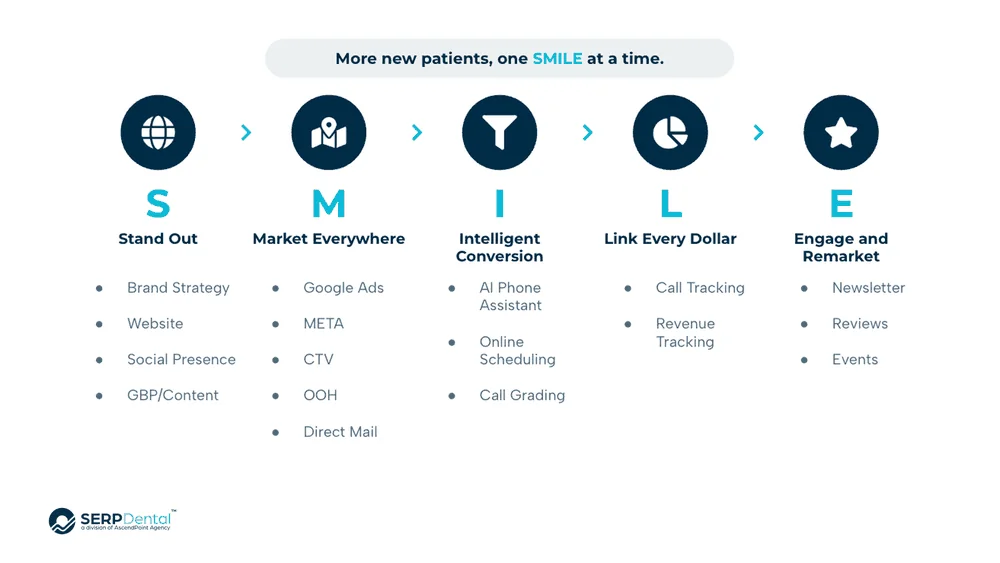
Stand Out is positioning, brand, website and reputation, including a fully optimized Google Business Profile and 100-plus reviews, which Moz's Local Search Ranking Factors study identifies as the top local ranking factor. Market Everywhere is showing up where patients actually look now: ChatGPT and Perplexity, Google, social media and community conversations. Intelligent Conversion turns traffic into booked appointments with AI phone assistants that never miss a call, online scheduling and automated nurture. Link Every Dollar is attribution from call tracking to PMS integration. Engage and Remarket keeps you in front of prospects who didn't book and brings back patients who went quiet.
Miss one and the others leak: without Intelligent Conversion your phone rings and nobody answers; without Engage and Remarket you leave the 70 to 80% of prospects who weren't ready today on the table. Strategy lives in S and M, the system in I and E, and measurement in L. Most agencies sell one or two of the five. I walk through each part in What Should a Dental Marketing Agency Actually Do for You? The 5-Part SMILE Checklist, with deeper dives in The AI-Era Dental Marketing Agency: What Changed in 2026 and What to Look For Now and How to Choose a Dental SEO Agency: The Local SEO Hierarchy the Best Ones Follow.
How do you score any dental marketing agency in 15 minutes?
Turn the three questions into a twelve-row scorecard, four rows per question, and put every candidate through it, your current agency included. One point for each "yes" you can verify with a number or a document. Read the score by group: fewer than three points in any group means that gap is open.
Turn the three questions into a twelve-row scorecard, four rows per question, and put every candidate through it, your current agency included. One point for each "yes" you can verify with a number or a document, not each "yes" you are promised.
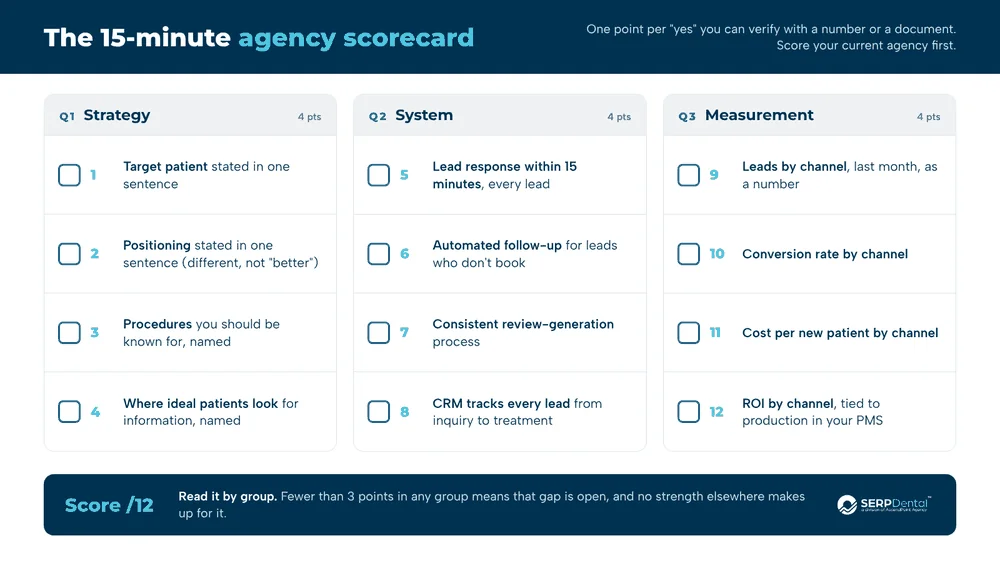
Read the score by group, not just the total. Fewer than three points in any group means that gap is open, and no strength elsewhere compensates: a 4-4-0 agency will execute your strategy brilliantly and never be able to prove it worked. A 4-4-4 is rare. Ask any agency that claims it to show you a real client dashboard with the name blurred. For the full interview script, see 15 Questions to Ask Before Hiring a Dental Marketing Agency (With the Answers You Should Hear).
Where SERP Dental fits
Since I have asked you to score us, here is how we answer. We won't spend a dollar of media until the target patient, positioning and procedures are written down. We build the conversion system before we scale traffic: AI phone handling, online scheduling, automated follow-up and a review process. And we report at the source-to-production level, so you see cost per new patient and ROI by channel. That system has taken practices from 5 implant consults a month to 20, cut cost per booked appointment by 60%, and lifted call-to-appointment conversion from 40% to 85%.
We are not the right fit for every practice. We work only with dentists and small dental groups, and we ask for the call tracking and PMS connection that measurement requires.
So, what is the best dental marketing agency? The one that scores twelve on your scorecard and shows you the numbers behind each point. To see where your own practice stands, book a free strategy session: my team runs the book's audits on your website, your Google and AI visibility, your reviews and your competitors, then a senior strategist walks you through the findings live, no charge and no obligation. Book your free strategy session and bring your current agency's last report. We will score it together.
Frequently asked questions
What is the best dental marketing agency?
The best dental marketing agency for your practice is the one that can prove it closes three gaps: a written strategy naming your target patient and procedures, a system that responds to every lead within minutes and follows up automatically, and measurement that reports cost per new patient and ROI by channel. Score candidates on those twelve points rather than on rankings or awards.
How much does a dental marketing agency cost?
Budget the media and the agency separately. For paid advertising, my benchmarks are a minimum of about $2,500 a month across Google and Facebook, an ideal range of $5,000 to $8,000, and $15,000-plus for aggressive growth. Agency fees sit on top of that. Judge the total by cost per new patient and return by channel, not by the size of the retainer.
How long before a dental marketing agency shows results?
Conversion fixes show results fastest: answering every call, following up every lead and optimizing your Google Business Profile with reviews can move numbers within the first 90 days, and a well-run Phase 1 typically adds 30 to 70 patients in three months. SEO is slower: foundation in months one to three, momentum by month six, real growth by months seven to nine, so commit to twelve months before judging it.
Should I hire a dental-specific agency or a general one?
The general-agency playbook was built for enterprise brands that can test many channels, wait six to twelve months and absorb failures. A dental practice needs returns in months and an agency that understands the patient journey, treatment values and practice management software integration. Specialization alone is not enough, though; a dental agency can still be missing strategy, system or measurement, so score it.
What reports should a dental marketing agency give me?
Not impressions, clicks or traffic. A useful monthly report shows leads by channel, conversion rate by channel, cost per new patient by channel and ROI by channel, with production pulled from your practice management system so every dollar ties back to its source. The summary should take 30 seconds to read; the detail behind it should be available any time you ask.
Sources
Keep reading

Patrick Hounsell is Co-CEO of SERP Dental, a division of AscendPoint Agency. His first job in digital marketing came before you could buy keywords on Google, and he went on to serve as CEO of a worldwide digital marketing firm. He has had a front row seat to search for more than 25 years.