

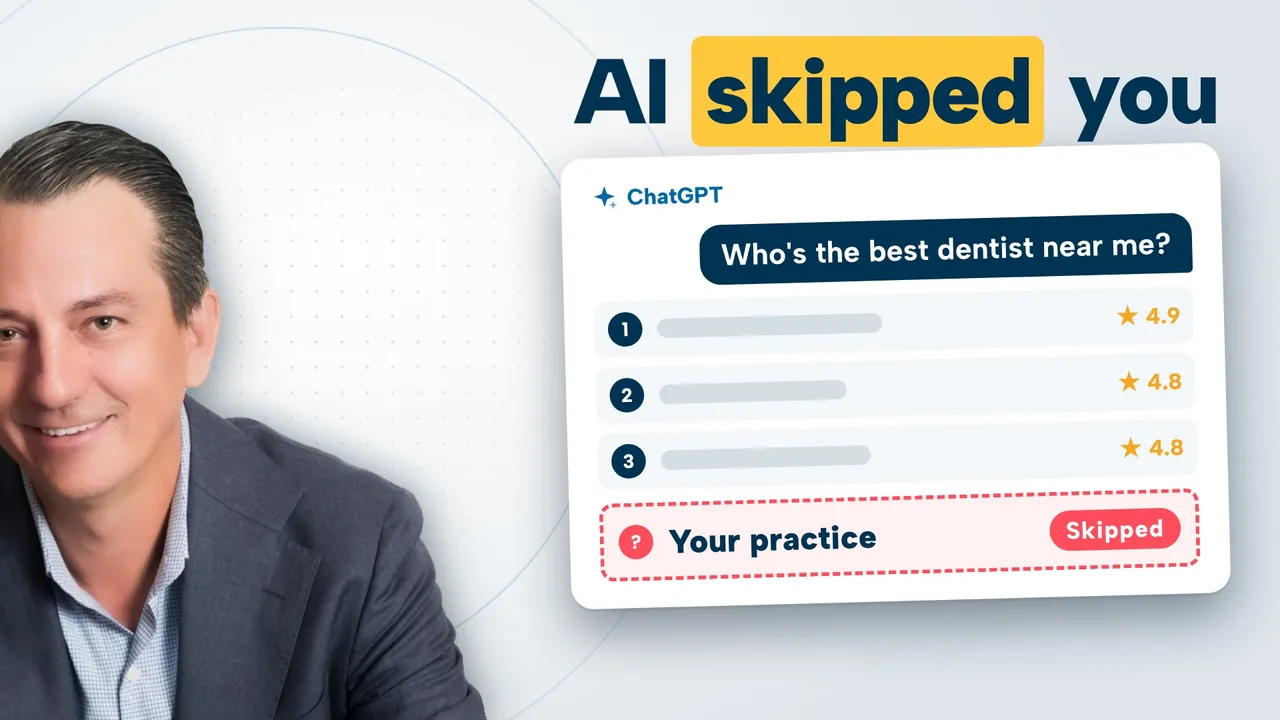
A patient asks ChatGPT which dentist near them is good for implants. It names a few practices. If yours is not on that list, you never got the chance to compete, no matter how good your clinical work is.
This guide shows how to get ChatGPT to recommend your dental practice with fixes you can start this week: letting AI bots into your website, building pages AI can quote, a Google Business Profile routine drafted by AI, a review strategy and a 90-day plan. In the tracking we follow, AI assistants are already how roughly 9 to 10 percent of new patients find a dentist, and that share keeps growing.
Watch the full training in the video below, or read on for the playbook.
Video chapters (21)
- 0:00Why AI isn't recommending your dental practice
- 3:10The four eras of digital marketing
- 5:14How new patients find a dentist today
- 7:40The new patient journey starts with a question
- 9:07Informational vs transactional searches and AI Overviews
- 11:39The agentic future of booking a dentist
- 13:49Why dental marketing fails and the SMILE framework
- 15:30Stand out: your website is your front office
- 18:26The 2x2 positioning exercise you can run with AI
- 20:39Get found: SEO, AEO and Google Business Profile
- 22:23SEO vs AEO: ranking vs being recommended
- 24:14Website fix 1: let AI bots in (robots.txt)
- 25:42Answer patient questions and build service pages
- 27:50Schema, proof and NAP consistency
- 30:02Google Business Profile posting routine with an AI prompt
- 33:18How AI decides who to trust
- 35:31Press releases as an AI authority signal
- 36:49Rewrite service pages for AI answers
- 38:51Review strategy that works
- 40:00Your 90 day AI visibility plan
- 45:02Q&A
Key takeaways
- Check yourwebsite.com/robots.txt today; many dental sites block AI bots without knowing it.
- Build one dedicated page per treatment that answers what it is, how much it costs and how long it takes.
- AI trusts what it can verify: named dentists with real bios, recent reviews, original photos and matching hours, address and phone.
- Schedule an AI prompt that drafts your Google Business Profile posts every Monday, with office manager approval before anything goes live.
- Run a 2x2 positioning exercise with ChatGPT or Claude to find messaging only your practice can own.
Why isn't ChatGPT recommending your dental practice?
AI tools recommend the practices they trust most, not the pages that rank for a keyword. If your website blocks AI bots, buries answers in long procedure descriptions, or disagrees with your Google Business Profile, the engines cannot verify you, so they recommend someone else.
In 25-plus years of digital marketing, I have seen four big shifts: directories, Google search, Facebook and now AI. Each one rewarded early adopters.
The patient journey itself looks familiar: search, website, reviews, phone call, appointment. What changed is the first step. It now starts with a question, like "what's the difference between an implant and a bridge?" Questions are longer and carry more intent than a keyword, so the way you get found has to change too. We cover that shift in more depth in how patients use AI to find a dentist.
The upside: patients who arrive through an AI tool show more trust in the recommendation, which tends to mean better conversion. In the new patient source data we track for clients, AI is growing fast as a channel.
How does AI decide which dental practice to trust?
Google asks "is this the best page for this keyword?" AI asks "who is the most trusted source for this answer?" That means AI rewards entity and brand authority: clear answers, structured data, proof you are real, and consistent mentions of your practice across many third-party sources.
Think of SEO as Google's walled garden, where Google curates who shows up. AI engines work more like an open ecosystem, reaching outside the garden to decide whose answer is authoritative. If you want the full comparison, read SEO vs AEO for dentists.
AI prioritizes clarity, structure and authority. The content that wins has:
- Direct answers that satisfy the patient's intent.
- Structured data that machines can read.
- Original authority signals (what Google calls E-E-A-T) showing you know your field.
- Multimodal media: videos, pictures and citations.
- Topic depth, covering a treatment comprehensively.
- Consistent brand mentions across third-party sources such as reviews, PR, research, citations, content and podcasts.
Both matter today, since most traffic still comes from Google. Treat SEO and AEO as a long-term business asset, not a service you buy: steady new patient flow without heavy ad spend makes a practice more valuable if you ever sell.
How do you stand out when every dental website sounds the same?
Find your white space with a simple 2x2 exercise: ask ChatGPT or Claude to compare your website with nearby practices on two axes, outcome-led versus procedure-led messaging and ownable versus generic claims. Differentiated messaging helps patients choose you and gives AI engines a reason to treat you as distinct.
Your website is your front office. You would not leave a worn-out couch in the waiting room, yet many practices treat the website as a necessary evil. A $500 website built three years ago is not doing the job for SEO or AEO, and it is not reflecting your brand either.
AI content tools make it easy for practices to sound alike: same stock photography, same generic copy. That sameness hurts your brand and your rankings, because the algorithms look for authority and differentiation.
The two axes
- Outcome-led vs procedure-led. Do you lead with the results patients get, or with your equipment and how careful you are? Patients already expect good tools and careful care. That is an expectation, not a differentiator.
- Ownable vs generic. Is your main claim something only your practice can say, or could any office down the street put it on their homepage?
| Outcome-led | Procedure-led | |
|---|---|---|
| Ownable | The white space: results patients want, in a claim only you can make | Distinct, but talks about you instead of the patient |
| Generic | Patient-focused, but sounds like everyone else | The sea of sameness: equipment and care claims patients already expect |
Run it yourself
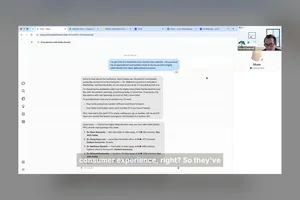
Ask ChatGPT or Claude to look at the practices within five to ten miles of you, or try a prompt along these lines: "Read my website, compare it to five websites in my area, and tell me if I have ownable, outcome-led messaging compared to the others. Put it in a 2x2 matrix." It will build the chart for you. You can see the exercise at 18:26 in the video above.
How to get ChatGPT to recommend your dental practice: 6 website fixes
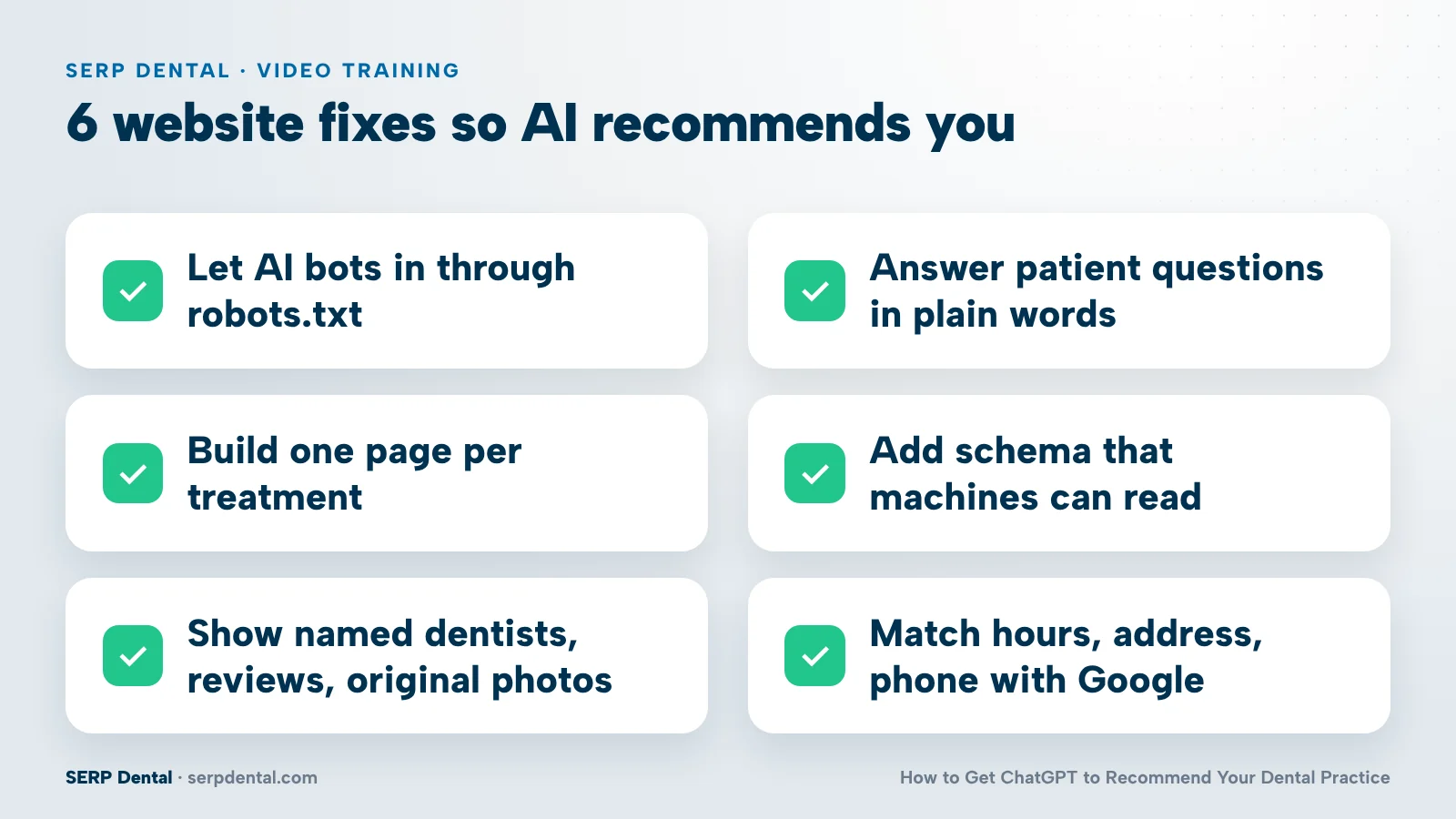
Six website fixes do most of the work: let AI bots in through robots.txt, answer patient questions in plain words, give each treatment its own page, add schema, show verifiable proof, and keep your name, address, phone and hours identical to your Google Business Profile.
Your website has two audiences. Patients speak human. Google and the AI bots speak technology. You need both languages on the site. The walkthrough starts at 24:14 in the video above.
1. Let the AI bots in
Type yourwebsite.com/robots.txt into your browser. This small public file tells bots whether they may read your site. A lot of dental sites block AI bots without knowing it, and that one line can hide you from every AI platform.
What to look for, in plain terms:
- Each block starts with User-agent, which names the bot. An asterisk means "all bots."
- Below it, Allow lines open parts of the site and Disallow lines close them.
- A red flag is Disallow: / under ChatGPT's bot or under the asterisk. That closes your whole site to them.
If you see that, ask whoever manages your website to allow the AI bots.
2. Answer patient questions
AI answers questions, so ask and answer them on your website. On your implant page, add an FAQ section in the words patients use: Does it hurt? How much? How long? Keep each answer short and direct. The easier you make it for the engine to return an answer, the more likely it is to return yours.
3. Give AI a page to point to
Do not cram all your services onto one page. Build a dedicated page for every treatment that matters to you, with in-depth content on cost, process and recovery. In-depth pages are more likely to be found and to earn authority from both AI and search engines.
4. Add schema
Schema is code patients never see that tells machines who you are and what is on the page. It is easy to test whether it is there, so check that your site has the right schema in place.
5. Show proof AI can verify
AI recommends practices it can verify. It looks for named dentists with real bios and credentials, review volume and recency, and original photos instead of stock images.
6. Keep your details consistent
Your hours, address and phone number must match between your website and your Google Business Profile. When the two disagree, the engines cannot tell which one to believe, and your authority drops.
What should a dental service page look like so AI can quote it?
Put the answer in the first three sentences: what the treatment is, how much it costs and how long it takes. Then attach a named doctor, use real patient questions as headers, add an FAQ with schema, and show reviews as proof.
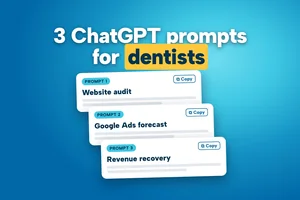
Pick a random service page on your site and compare it with this table. If the page was built more than 18 months ago, it probably looks like the left column. For a faster check, our ChatGPT prompts for dentists include a website audit prompt.
| Older service page | Page built for AI answers |
|---|---|
| Long-form description of the procedure | The answer in the first three sentences: what it is, how much, how long |
| Heavy on technology and the care given | Answer stands behind a named doctor |
| Generic headers | Headers that ask real questions, like "How much do dental implants cost?" and "Am I a candidate?" |
| No FAQ, or FAQ with no markup | FAQ section with the right schema behind it |
| Stock photos | Proof on the page, such as your reviews |
Start with the treatments you most want to grow. If the site itself is the bottleneck, that is what our dental website design team rebuilds.
How often should a dental practice post on Google Business Profile?
Post every week, about eight posts a month, because activity and recency matter. You can automate the drafting: schedule an AI prompt that writes posts every Monday morning and sends them to your office manager for approval before anything goes live.
Your website is what patients see. Your Google Business Profile is the mass under the iceberg, the single biggest driver of local search rankings and local AI answers. It holds your reviews, categories, office photos, services, posts, Q&A, hours, products and attributes. Use all of it.
The prompt
Here is our version of the routine, which you can schedule in Claude or ChatGPT for every Monday at 7 a.m. You can see the original prompt at 30:02.
Role: You are the marketing assistant for our dental practice. Every Monday at 7 a.m., draft this week's two Google Business Profile posts in our practice's voice.
Topics: Follow our monthly posting plan and rotate topics. Never repeat a topic or angle we have already posted.
Photo: Choose one original photo from our photo library for each post. No stock photos.
Content: Answer a real patient question, keep it local and specific to our area, and end with one clear call to action that matches the topic.
Link: Link to the matching service page on our website, never the home page, and add tracking to every link.
Approval: Send the drafts to our designated office manager. Nothing goes live without approval.
Privacy: Never include patient names or health details in a post.
A month of posts
| Week | Post 1 | Post 2 |
|---|---|---|
| Week 1 | Service spotlight | Seasonal topic |
| Week 2 | Patient FAQ | Meet the team |
| Week 3 | An offer | Proof of success |
| Week 4 | Use your insurance before the year is up | Patient FAQ |
What makes a post good
The prompt already asks for a real question, local detail, one call to action and a tracked deep link. The part only you can supply is the photo library: hire a photographer once to shoot you, your staff and your rooms, and let the AI pull from that folder.
Do press releases and reviews help a practice get recommended by AI?
Yes. A press release gets picked up by multiple authoritative sources, which tells AI your practice carries real authority. Reviews show AI that your practice is real, trusted and active, as long as the volume keeps growing and you reply to every single one.
Press releases are back
Get into a quarterly rhythm with a press release distribution service. Good triggers include:
- A new staff member joining the practice
- A new procedure you now offer
- A successful outcome worth sharing (with no patient names or health details)
You are not writing these mainly for people. You are writing them for the engines.
A review strategy that works
Everyone knows reviews matter, but you need a strategy that shows a constantly growing review base. You probably already have software that sends review requests. The technology is not the how. It is the who, and how you use it.
- Ask about the visit first. Ask the patient how their visit was and let them answer.
- Then ask for the review. Do not open with the review request.
- Send the review link within two hours of each visit.
- Reply to every review, so the profile stays active and recent.
Your 90-day AI visibility plan
Spend the first 30 days on foundational quick wins like bot access and your Google Business Profile, days 31 to 60 on new and rewritten service pages, and days 61 to 90 on authority: local prompt research, press releases and review replies.
This is the plan we would give any practice before knowing anything about it. You can see the full plan at 40:00.
| Phase | Focus | What to do |
|---|---|---|
| Days 1 to 30 | Foundational quick wins | Make sure AI can get to your site (robots.txt). Set up an llms.txt file. Send a review link within two hours of each visit. List every service and add photos in your Google Business Profile. Start a posting rhythm. |
| Days 31 to 60 | Content | Create pages for the services you want to grow, each with an answer, a price, a timeline and the doctor's bio. Add FAQs. Match the content on your Google Business Profile and your website. |
| Days 61 to 90 | Authority | Ask ChatGPT what the most popular dental prompts are in your area. Start a quarterly press release. Reply to every review. |
The llms.txt file and the other quick AEO wins are covered step by step in our guide to answer engine optimization for dentists.
Where to start this week
Start with the two checks that take minutes: open yourwebsite.com/robots.txt to confirm AI bots are allowed, and compare your website's hours, address and phone with your Google Business Profile. Then schedule the Monday posting prompt and run the 2x2 positioning exercise.
The best time to plant a tree was 20 years ago. The second best time is today. The same goes for your website: the best time to fix it was five years ago, and the next best time is now. Practices that start today will wake up in three years ahead of the ones that waited.
If you want a plan built around your market instead of a generic one, book a free strategy session. We will review your current rankings, AI visibility and website, and you can use the plan with your current team or agency.
Frequently asked questions
Does my Google Business Profile affect whether ChatGPT recommends my practice?
Yes. We see the Google Business Profile as the single biggest driver of local search rankings and local AI answers. Keep it complete with every service, real photos, categories and hours, post every week, and make sure your hours, address and phone number match your website exactly so AI tools are not left guessing which one to believe.
How do I check if my dental website is blocking ChatGPT?
Type your domain followed by /robots.txt into a browser. Look for a line that says Disallow: / under ChatGPT's bot or under User-agent: * (all bots). If you see it, your site is closed to that bot. Ask whoever manages your website to allow AI bots; it is a small text change.
Do I need a new website to show up in AI answers?
Not always. Many practices can start by rewriting their most important service pages so the answer appears in the first three sentences, adding FAQs with schema and showing named doctors and reviews. If your site is old, built on stock photos and generic copy, a rebuild may be the faster path.
Is it safe to use ChatGPT or Claude to write Google Business Profile posts?
Yes, if a person approves every post before it goes live and you keep patient information out of it. Never paste patient names or health details into a public AI tool, and have your office manager review each draft for accuracy and tone before publishing.
How long does it take for AI tools to start recommending my practice?
We lay the work out over 90 days rather than promising a date: quick technical and Google Business Profile wins first, then content, then authority. Track where every new patient comes from so you can see AI grow as a source over time.
Keep watching
Patrick Hounsell is Co-CEO of SERP Dental, a division of AscendPoint Agency. His first job in digital marketing came before you could buy keywords on Google, and he went on to serve as CEO of a worldwide digital marketing firm. He has had a front row seat to search for more than 25 years.