

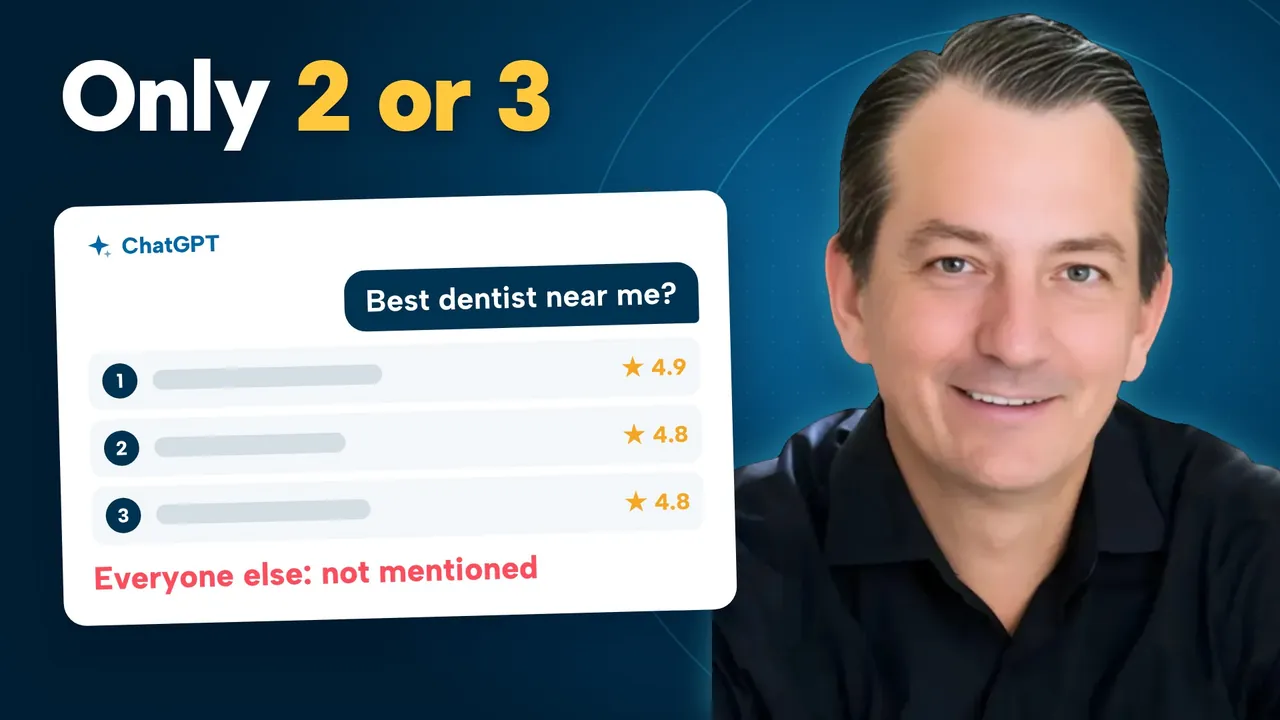
Ask an AI engine for a dentist near you and you rarely get a long list. You get a couple of names, in a city with hundreds of practices. If yours is not one of them, that patient may never see you. That is the real difference in SEO vs AEO: SEO ranks your page, AEO decides whether your practice is the answer.
The survey data we track puts AI at about 9 to 12 percent of how people now search for a dentist, and we expect that share to grow quickly. Google still matters most, but the rules for being picked by AI are different.
This guide puts SEO vs AEO side by side in one table, explains why AI names only a few practices and why ChatGPT and Gemini disagree, and covers the answer content that earns recommendations: video, cost transparency and Reddit. The full training is in the video below.
Co-hosted with Jane Levy of Plan Forward.
Video chapters (19)
- 0:00Intro: Jane Levy of Plan Forward
- 2:08Why patients search for a dentist with AI
- 3:57Patrick Hounsell: how AI is changing marketing for dentists
- 5:51How patients find dentists today
- 7:17Informational vs transactional searches
- 9:13Agentic commerce: AI agents choosing practices
- 13:38SEO vs AEO: walled garden vs open system
- 16:56Brand authority signals AI engines use
- 18:06Measuring AI visibility: three pillars
- 20:37Five things: publish original research
- 22:49Edit existing pages with questions and answers
- 24:18Answer questions in local forums and Reddit
- 25:28Make your website AI friendly
- 27:36Strategy session and free AEO report
- 32:11Q&A: Reddit account for the practice or the doctor
- 33:12Q&A: why AI shows only a few dentists
- 36:01YouTube and short video as answer content
- 37:37Cost transparency and membership plans
- 39:04Why different AI engines give different answers
Key takeaways
- SEO ranks a page inside Google's walled garden; AEO makes your practice the answer across an open system of AI engines.
- AI answers name only a few practices, chosen by authority signals and by what the engine knows about the person asking.
- Brand authority comes from reviews, structured data, PR, original research, expert citations, video, podcasts and community answers.
- ChatGPT and Gemini weigh sources differently, so score presence, position and impact on each engine separately.
- Publish answer content on cost, membership plans and pain, plus short videos that answer real patient questions.
SEO vs AEO: what is the difference for a dental practice?
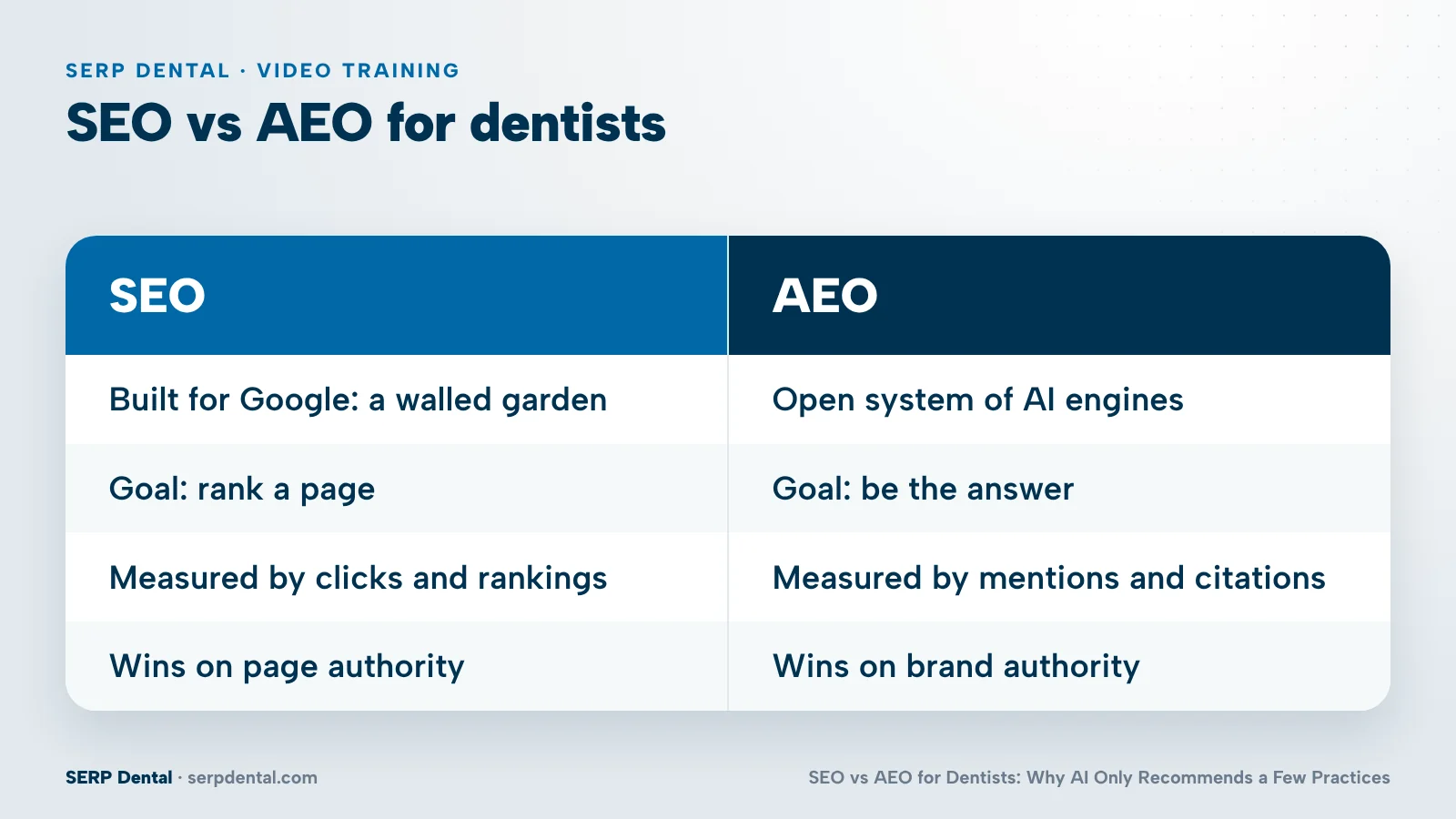
SEO gets a web page ranked in Google's results. AEO, answer engine optimization, gets your practice named as the answer when a patient asks ChatGPT, Gemini or Claude a question. SEO is built for one closed platform and rewards page authority. AEO works across an open system of sources and rewards brand authority.
SEO was designed by Google, for Google. In the industry it is called a walled garden: a pleasant place if you are Google, less so if you are anyone else.
AI is an open ecosystem. An answer engine pulls from your website, your reviews, press coverage, video, podcasts and community threads, then decides who it trusts. The S in SEO stands for search. The A in AEO stands for answer. That is the whole shift: you are no longer only trying to rank, you are trying to be recommended.
| SEO (walled garden) | AEO (open system) | |
|---|---|---|
| What you optimize | Visibility in search engines, mainly Google | Visibility across many AI platforms and sources |
| The result you want | Rank a page for a keyword | Be the answer: cited, mentioned and recommended |
| How you measure it | Clicks and rankings | Mentions, citations and recommendations |
| What the engine wants | The right content and documents in place | Trusted knowledge about your practice |
| The question it asks | Is this the best page for this search? | Who is the most trusted source to answer this? |
| The signal that wins | Page authority | Brand authority |
| Who controls it | Google sets the rules | No single gatekeeper; many engines weigh many sources |
The word that matters most in that table is trusted. You can see the full comparison in the video above at 13:38.
Why does AI only recommend a couple of dental practices?
An AI engine is not ranking every dentist in your area. It runs its own algorithm, combines what it knows about the person asking with what it knows about local practices, and returns the few it sees as clear authorities. Practices with visible, specific content about what they are known for make that short list.
Our co-host, Jane Levy, tested this before the session. She asked an AI engine for a dentist near her. It thought for about a minute and came back with two local practices, in an area where there must be hundreds. Here is what happens behind an answer like that.
- The engine knows something about the person asking. If someone uses an AI tool regularly, it has learned their preferences from past chats. It tries to connect what it knows about the patient with what it knows about the practices, so the same question can produce different names for different people.
- It looks for points of authority. The engine scans for signals that a practice is a trusted source on exactly what was asked.
- It favors specific, visible content. The practices that came back almost certainly had content on their site that ranks high for authority, the kind of thing that turns into a line like "this practice is near you and known for Invisalign."
A page of search results lists many websites. An AI answer names only a few, so you need to be the obvious authority for something specific. Hear the full answer at 33:12.
Example: publish the proof you already have
Many dentists track Net Promoter Scores, but they only carry weight with AI if you publish them. Post a short, readable report: how your score has trended over time, with snippets of what patients said when recommending you (de-identified, with no patient names or health details). One piece of content like that can become several more.
What brand authority signals do AI engines look for?
AI engines judge brand authority from many places at once: reviews, structured data, the content on your website, press coverage, original research, expert citations, video, podcasts and online communities where questions get answered. No single signal wins. The practices AI recommends show up consistently across several of them.
- Reviews. What patients say about you is one of the first things an engine checks.
- Structured data. Schema and other structured data tell machines who you are, where you are and what you do.
- Your website. The engines read the data and content on your own pages.
- PR. A press release is a strong authority signal. Engines read coverage as a sign the practice is worth listening to.
- Original research. Engines want distinctive answers. Real data from your practice stands out from what the industry calls "AI slop."
- Expert citations. You are the expert. Being quoted and cited as one counts.
- Video and podcasts. Both give engines more of your expertise to read.
- Social communities. Places where people ask questions and get answers, like Reddit and local Facebook groups.
Notice how few of these live inside Google. That is the open system at work.
The fastest ways to build these signals are covered step by step in our guide to five easy AEO wins for dentists. For the technical side of your site, such as llms.txt and schema, see how to get ChatGPT to recommend your dental practice.
Why do ChatGPT, Gemini and other AI engines give different answers?
Each AI engine draws on different sources and puts different weight on them, so the same practice can look strong on one platform and weak, or even negative, on another. The core principles of authority are the same everywhere, but you have to check every engine your patients actually use.
When we audit a practice, the differences are easy to see. Some practices show up more on ChatGPT than anywhere else. Some show up more negatively on Gemini. The engines are reading different sources and trusting them differently. ChatGPT, for example, likes YouTube.
Consumers mostly gravitate toward ChatGPT and Gemini, so those are the two to check first. Claude is better known among coders today. The discussion on this starts at 39:04.
Measure each engine on three pillars
We built a visibility score around three pillars. Run the same patient questions on each engine and score every answer:
| Pillar | The question it answers |
|---|---|
| Presence | When a patient asks, does your practice show up at all? |
| Position | When you show up, are you first, third or fifth? |
| Impact | Is the message about you a recommendation, or not? |
Scoring engine by engine matters because the fixes differ: being missing on Gemini is a different problem from showing up there negatively. AI reporting is still young, so start small and measure.
Does video help a dental practice show up in AI answers?
Yes. ChatGPT in particular likes YouTube, and short video on TikTok and Instagram gives AI engines more of your expertise to read. The key is to make each video answer a question, because content built in answer format is easy for engines to index and quote.
Many dentists hold back because they assume the only people watching will be family. That misses the point. You are creating content for potential patients and for the engines, so the engines have something to read.
Ideas that work in answer format:
- "10 things people should ask their dentist." Ten questions with ten answers is easy to film and easy for an engine to index.
- Why patients look for a new dental practice. Walk through the reasons and what to look for.
- The cost and comfort questions you hear every day. "How painful are implants?" makes a better video title than a generic service overview.
You do not have to be obvious about it every time. Just keep one question in mind while you plan: how will this be read as an answer? If you want help producing it, our dental video and photography team shoots this kind of content.
Why are cost transparency and membership plans strong AEO content?
Cost and pain are the two topics patients most want demystified, and AI engines reward the practice that answers them clearly. Explaining how pricing works, including membership plans and financing, makes your practice the authority on cost without publishing a full price list.
Patients often assume dental care is not affordable. Many do not know membership plans exist, or that there are ways to finance treatment. The practice that explains it becomes the source the engines cite.
It also matches how patients search now. As Jane Levy of Plan Forward, a membership plan platform for practices serving uninsured patients, pointed out, AI search is far more granular than "dentist near me." Patients ask for a reasonably priced dentist, one close to home, or one that takes their insurance. On Facebook and Instagram, results are simply served to people. AI lets patients say exactly what matters to them.
Membership plans help because a bundled price is transparent. They answer the question every practice dreads: "How much is a cleaning?" On the phone, the front desk first has to work out whether the patient needs a periodontal cleaning, a comprehensive exam or a regular exam. A clear membership offer gives a straightforward answer instead. Hear that exchange at 37:37.
Cost content worth publishing
- How pricing works for your most-asked treatments, such as implants, Invisalign and cleanings, and what changes the cost.
- What your membership plan includes and who it is for, especially uninsured patients.
- The ways patients can finance treatment.
- Which insurance plans you accept.
- A short question and answer paragraph on each service page, like "How much does Invisalign cost?"
Should a dental Reddit account be in the practice's name or the doctor's?
Both. Create the Reddit account in the practice's name, then answer as the doctor. That way the practice brand and the doctor's personal expertise are both attached to every helpful answer, and AI engines can connect the two as one authority.
AI engines love Reddit because it is structured data in its simplest form: someone asked a question, someone gave an answer. If you have never spent time on Reddit, it can feel a little strange. Go in as the expert, not the marketer.
- Find your local subreddit or community forum and answer dental questions where you have real expertise.
- Do the same in local community Facebook groups, which are often full of dental questions.
- Answer the question that was asked. Do not turn the reply into an ad.
- Never share patient names or anything that could identify a patient or their health.
Consistent, useful answers build the community authority the engines pick up.
Do dentists still need SEO if AEO is the future?
Yes. In our research, Google still drives about 80 percent of traffic, so SEO remains the foundation and AEO builds on it rather than replacing it. The practical change is that your website now serves three audiences: your patients, Google, and AI engines like ChatGPT, Claude and Gemini.
We have seen this cycle before. In more than 25 years in digital marketing, I have watched directories, search advertising and social each change not just how people discover providers, but how they choose them. AI is the next round.
| Audience | What your website needs to give it |
|---|---|
| Patients | A great brand experience |
| Pages it can read and understand | |
| AI engines | An llms.txt file, structured data and schema, and content in question and answer form |
That is why we treat SEO and AI ranking as one program rather than two.
Then look further ahead. AI is starting to allow automated decision making, called agentic commerce, where a personal AI agent researches, compares and books on someone's behalf. We expect it to reach healthcare in the next two to three years. A patient might tell an agent to find the best implant dentist within 20 miles who takes their PPO, and the agent would check credentials and book with the practice directly. Practices that are ready will have online scheduling availability and a practice management system connected to revenue attribution. We cover that shift in how patients use AI to find a dentist.
Where to start this week
Start by finding out where you stand on each AI engine, then build one authority signal this week. The easiest high-impact move is adding a question and answer paragraph to the service page for the treatment you want more of.
- Ask ChatGPT and Gemini the questions your patients ask, such as "best implant dentist near me." Note your presence, position and impact.
- Go to the page for the treatment you want more of and add a question, like "How painful are implants?", with a direct paragraph answer.
- Publish one cost explainer, including your membership plan if you offer one.
- Record one short video that answers a common patient question.
- Set up a Reddit account in the practice's name and answer one local question as the doctor.
Keep the big picture in mind: SEO ranks pages; AEO answers questions. To be the answer, you have to be the authority. Publish authoritative information, take part in authoritative communities and make your practice discoverable to the technology.
If you want a second set of eyes on your market and your AI visibility, book a free strategy session and we will build the plan with you.
Frequently asked questions
What does AEO stand for in dental marketing?
AEO stands for answer engine optimization. SEO is search engine optimization, the work of ranking a web page in Google. AEO is the work of making your practice the answer that AI tools such as ChatGPT, Gemini and Claude give when a patient asks a question, so you are cited, mentioned and recommended rather than just listed.
How many patients use AI to find a dentist?
The survey data we track puts it at about 9 to 12 percent of people today. Word of mouth, search engines, online reviews and insurance providers are still the main ways patients find a dentist, but AI is the new channel and we expect its share to grow quickly as more people use these tools every day.
Do I have to publish my full price list to show up for cost questions in AI?
No. You can be the authority on cost without a full price list. Explain how pricing works for common treatments, what changes the cost, what your membership plan includes and how patients can finance care. Clear, transparent answers to cost questions are what AI engines look for, and they also save your front desk time on the phone.
Will AI agents book dental appointments for patients?
That is where AI is heading. In agentic commerce, a personal AI agent researches options, checks credentials and books on someone's behalf. It is arriving in other industries first, and we expect it in healthcare within the next two to three years. Online scheduling availability and a practice management system connected to revenue attribution help a practice get ready.
Do Net Promoter Scores help a dental practice show up in AI?
Only if you publish them. A score sitting in a dashboard tells AI engines nothing. Put it on your website in a readable format, such as a short report on how your score has trended over time with de-identified snippets of what patients said, and it becomes content an engine can read and cite.
Keep watching
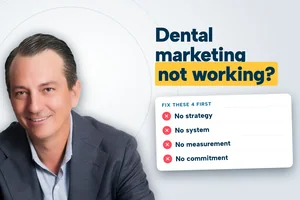
Patrick Hounsell is Co-CEO of SERP Dental, a division of AscendPoint Agency. His first job in digital marketing came before you could buy keywords on Google, and he went on to serve as CEO of a worldwide digital marketing firm. He has had a front row seat to search for more than 25 years.