

The phone isn't ringing like it used to. New patient numbers are flat, the agency report looks fine, and you are starting to wonder whether it is time to fire them and hire someone new. If your dental marketing is not working, a new agency is rarely the first fix.
In our experience, most practices are not running the wrong tactics. They are missing the structure around those tactics: a strategy, a system, a way to measure results and the patience to let campaigns work. Swap agencies without fixing that, and the next one hits the same wall.
This guide, based on our training on how to make your dental marketing work, covers why marketing feels harder right now, the four reasons it fails, how to build a marketing system that connects to revenue, and the exact 30/60/90-day plan I would follow if a practice's marketing had stalled.
Video chapters (18)
- 0:00Fix your marketing before hiring another agency
- 2:02The market: patients are still spending on dental care
- 3:13Why dental marketing is hard: competition and sameness
- 4:31The biggest change in marketing: the AI era
- 8:10The marketing system: presence, programs, analytics
- 9:32Your website as an asset: six jobs it must do
- 12:23The marketing funnel: brand vs demand generation
- 15:02Demand gen tactics: SEO, AEO, Google Ads, Maps
- 17:44How patients choose providers now
- 19:16Informational queries and AI Overviews
- 21:54SEO vs AEO: rank the page vs be the answer
- 25:26Brand marketing: newsletters, events, video
- 29:09Email lists and Meta lead magnets
- 32:12Performance analytics: measure business outcomes
- 35:55Lead tracking, text back and nurture
- 42:37Four reasons dental marketing fails
- 44:46Your 30, 60, 90 day marketing plan
- 47:17Free SEO and AI visibility reports
Key takeaways
- Patients have not stopped spending on dental care. They have changed how they choose a provider.
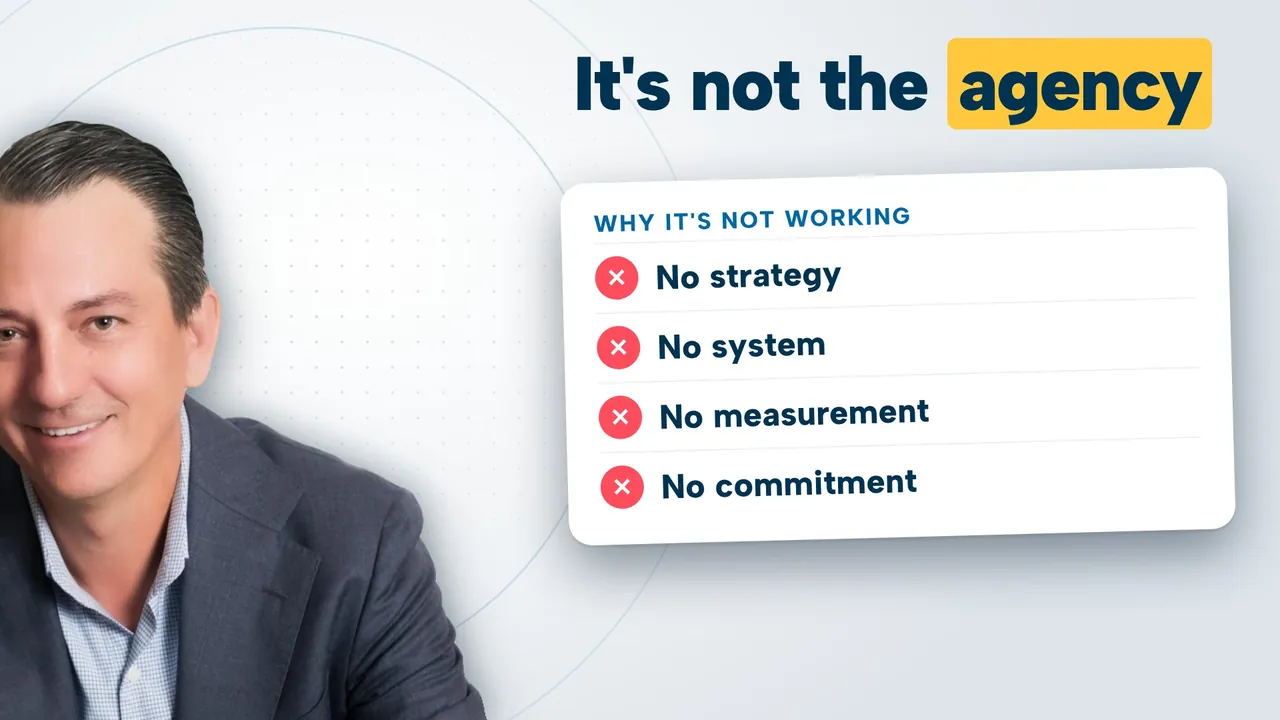
- Most dental marketing fails for four reasons: no strategy, no system, no measurement and no commitment.
- Treat marketing as one system: presence, programs and performance analytics working together.
- Measure business outcomes: new leads, new patients, revenue generated and new reviews.
- In the first 30 days, audit your website, SEO and Google Business Profile, then set up lead tracking.
Is your dental marketing not working, or is it the market?
It is usually not the market. Spending on dental procedures is still expected to grow over 6% this year, and the wellness economy has passed the $2 trillion mark. Patients have not stopped spending. What changed is how they find and choose a dentist, and many practices have not adapted yet.
There is also still a large population of untreated adults. The demand is there; the question is whether patients find and choose you. See the market picture at 2:02.
Why dental marketing is genuinely hard
I have worked in marketing across banking, consumer goods, e-commerce, entertainment and financial services over the last 25 years. Dental is not an easy category. Four things make it tough:
- Competition. One commonly cited statistic says the average patient has over fifteen practices competing for their attention within a five-mile radius.
- Sameness. When we analyze practice websites, nine out of ten look pretty similar to each other.
- Reactive habits. New patient flow runs in cycles, and practices tend to change their marketing in reaction to each dip.
- Seasonality. Seasonal highs and lows make it hard to predict and plan.
The biggest shift in fifteen years
We are also in the middle of the biggest change in marketing in the last fifteen years. Digital marketing has had four key moments: the early portals and directories, Google and search advertising, social media, and now AI assistants like ChatGPT.
AI affects your practice in two ways. Patients use it to find providers, which is a patient acquisition problem. And practices can use it to convert and retain patients through scheduling, intake, follow-ups and recalls. That integration of marketing and business systems is the opportunity. In the short term, it is also why tactics that worked in the past now underperform.
The 4 reasons dental marketing isn't working
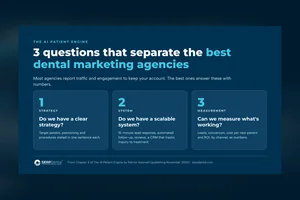
Dental marketing usually fails for four reasons: no strategy, no system, no measurement and no commitment. In most practices we review, the individual tactics are not wrong. The approach around them is incomplete, and fixing these four gaps does more than switching agencies.
| Reason | What it looks like | The fix |
|---|---|---|
| No strategy | Marketing started without a roadmap, a defined target audience or clear positioning | Decide who you are going after first, and why, before buying any tactic |
| No system | Disconnected tactics with no scalable processes, tools or automated workflows | Run presence, programs and analytics as one connected system |
| No measurement | No report showing leads, new patients and revenue by channel | Track business outcomes from first call to production |
| No commitment | Campaigns abandoned the first time results dip | Use your own history to judge normal swings, and stay the course |
If I had to rank them, measurement would be number one. If you do not know what each piece of your marketing is doing, you cannot fix it.
Commitment is the one owners underestimate. We run a lot of marketing for ourselves, and we go through stretches where it is not working as well as it used to. We stick with it because we have five years of history that tells us how it is supposed to behave.
What is a dental marketing system?
A dental marketing system has three parts that work together: your presence (where you exist online), your programs (how patients find and choose you) and your performance analytics (how you measure what works). Marketing breaks down when practices buy individual tactics instead of building all three.
| Component | What it covers | The question it answers |
|---|---|---|
| Presence | Website, mobile site, social media, your digital footprint | What do patients see when they look you up? |
| Programs | SEO, AEO, Google Ads, Google Maps, direct mail, newsletters, events, email, Meta ads | How do patients find you, and why do they choose you? |
| Performance analytics | Lead tracking, nurture, revenue attribution, reviews, call scoring | Which channels produce new patients and revenue? |
Most people think of marketing as only the middle row, and approach it as individual tactics. That is one of the biggest reasons it underperforms. See the full marketing system at 8:10.
What does a dental website need to do?
Your dental website needs to do six jobs well: be fast, fit your brand, let patients transact, act as a destination hub, work as a communication tool and carry content that builds authority. Treat it as an asset on par with your office, not an expense to minimize.
You would not let your reception room look dated. Your website is the first part of the patient experience, so it deserves the same standard as your waiting room and operatories. Social media is similar: the cost is mostly time, but you still need to show up where patients are.
- Fast. Speed helps patients, and it helps the engines that index your site and return it in searches.
- On brand. A custom design that reflects your clinical approach and unique identity, not a template that looks like every other site in town.
- Transactional. Patients can book online or complete some kind of transaction.
- A destination hub. A place patients come back to and engage with you.
- A communication tool. Patients can leave messages and get answers.
- Authoritative content. Content that establishes your expertise.
All six need to work together. A fast site with no online booking, or a beautiful site with thin content, still underperforms. If your site misses more than one of these, start with a dental website built around these six jobs.
Brand vs demand generation: which does your dental marketing funnel need?
You need both. Demand generation reaches patients who already know they need a dentist, through search, Google Ads and Maps. Brand marketing reaches people who do not know they have a need yet. If you never refill the top of the funnel, converting patients at the bottom gets harder over time.
Every patient moves through the same funnel: awareness, interest, consideration and then booking. Different tactics fit different stages.
| Brand marketing (top of funnel) | Demand generation (bottom of funnel) | |
|---|---|---|
| Who it targets | People who do not know they have a need | People who know they have a need, like a toothache |
| Goal | Help them realize the need and remember you | Be found and chosen when they search |
| Typical tactics | Newsletters, events, streaming TV and video, social media ads, press releases | SEO, AEO, Google Ads, Google Maps, direct mail, directories |
| Timeline | Builds over time | Responds quickly |
Search has changed in the last 12 months
Most demand generation is search-centric, and search has changed dramatically in the last 12 months. If you are running SEO, Google Ads and Google Maps the same way you were a year ago, odds are you have not adapted.
Word of mouth is still the top way people find a healthcare provider, followed by search engines and insurance provider directories. AI assistants now rank fourth. Even referrals lead back to search: 92% of people say they do their own research to validate a recommendation.
Search now splits into informational questions (about 80% of searches, which increasingly return an AI answer) and transactional searches like "dentist near me" (the other 20%, which return ads, maps and organic listings). We cover that split in depth in our guide to Google AI Overviews and dental SEO, and how to become the answer AI engines give in answer engine optimization for dentists.
How do newsletters, events and email bring in new patients?
Brand tactics like newsletters, events and email keep your practice in front of people until they are ready to book. Email is the most overlooked of them: you own the audience, open rates are high, there is no algorithm in the way and the cost is predictable.
In brand marketing we used to say a person needed to see an ad 12 times before taking action. Brand tactics deliver that frequency.
Brand tactics that work in dental
- Newsletters: a cost-effective, ongoing way to reach existing patients and subscribers with content that helps them recognize a need.
- Events: virtual or in person, such as an in-office talk on dentistry and sleep.
- Streaming TV and video ads: still the most compelling brand format, and now possible to target more cost-effectively.
- Social media ads: Facebook and Instagram build familiarity over time while people scroll.
- Press releases: they do not drive an immediate action, but they build authority and brand.
Why email deserves more attention
Your best potential patient is your existing patient. Many people think of the dentist only twice a year for a checkup. Email is the best way to show them everything else your practice offers. Email gives you:
- An audience you own
- High open rates, with no algorithm deciding who sees your message
- Segmentation and personalization
- Automated sequences
- A predictable cost
How to grow your email list
- Connect your practice management software. Your patient contact information already lives there.
- Run Meta ads to lead magnets. This is the best use of Meta ads in dentistry. Many practices have run a Meta campaign that produced leads nobody was ready to book. Pointing Meta at list building matches what the channel does well.
- Partner up. Run joint emails with referral partners or equipment manufacturers.
- Use events, webinars and website forms to capture new subscribers.
How to measure dental marketing (and what to track)
Measure business outcomes, not activity. At minimum, every month you should see how many new leads came in, how many became new patients and how much revenue those patients generated, plus how many new reviews you earned. If your report cannot show those numbers, you cannot optimize anything.
Performance analytics is where we suggest investing first, even before programs. If you cannot measure it, it did not happen.
Build a flywheel, not a spreadsheet
The practices that lead in marketing treat analytics as a connected platform. Marketing feeds lead management, lead management feeds revenue attribution, attribution feeds review requests and remarketing, and the whole loop is analyzed and improved. Whatever tool you use, look for these capabilities:
- Track every lead from every channel in one system: website, SEO, Google Ads, social and offline marketing, with the lead's name, number and source.
- Capture call details: what the patient called about and how the call ended.
- Text back missed calls automatically. When nobody answers, an automatic "sorry we missed your call" text with a scheduling link starts the nurture process.
- Nurture unscheduled leads with friendly reminders at set intervals until they book.
- Attribute revenue by channel. Connecting to your practice management software (PMS) links the caller's name and number to the patient record, so you can see new patients and revenue from SEO, paid ads and social, plus projected revenue for forecasting.
- Make reviews part of the process. Lead becomes patient, patient gets a review request. Reviews should not be an isolated activity.
- Score calls. Scores can feed back to Google Ads to find more leads like your best ones, and they help coach your front desk on how calls are handled.
We built these pieces into one platform because they are part of the same revenue process. You can learn more about dental lead tracking and analytics, or watch the lead tracking walkthrough at 35:55.
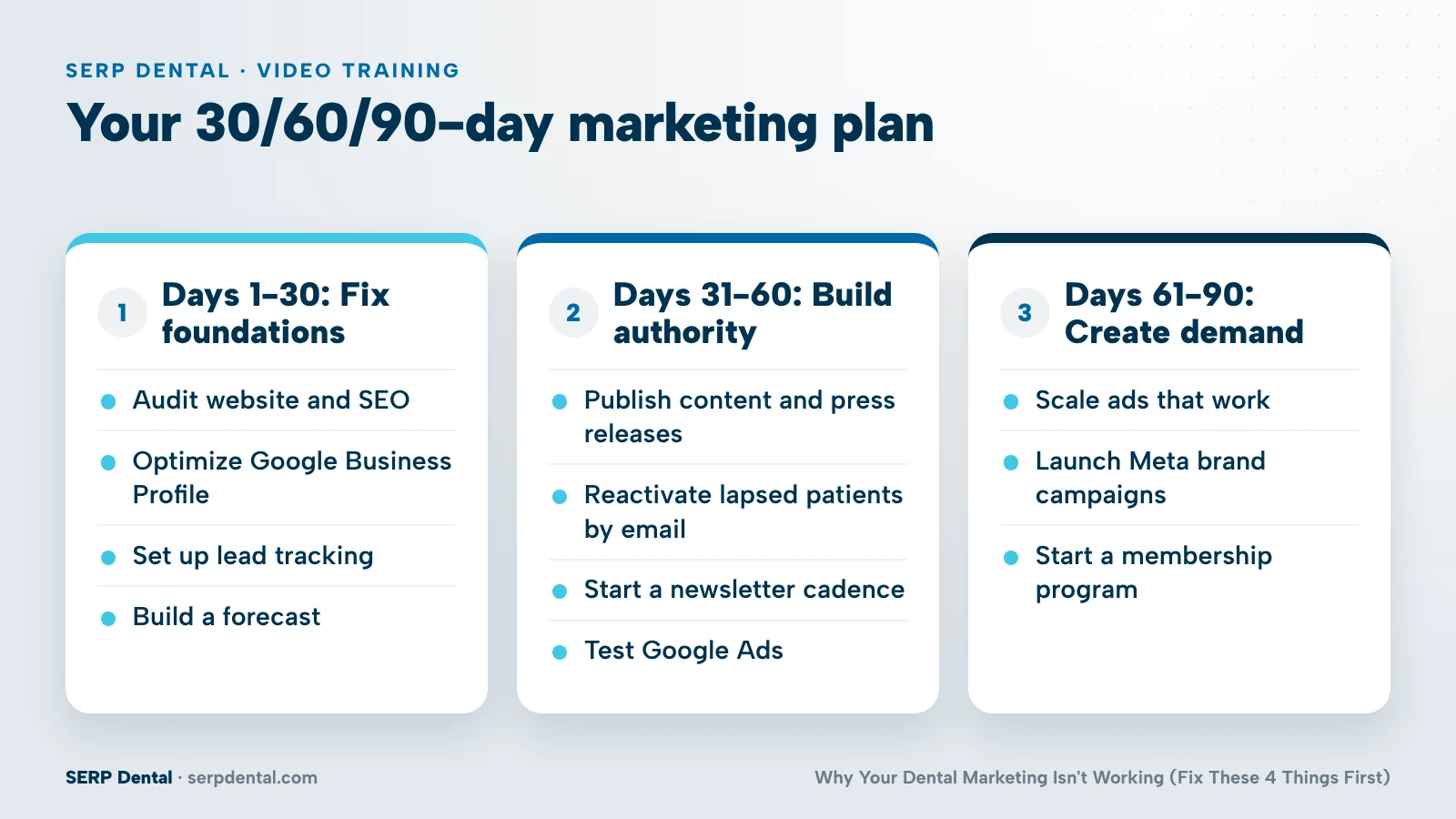
A 30/60/90-day dental marketing plan
If your marketing has stalled, spend the first 30 days fixing foundations and setting up measurement, the next 30 building authority and testing Google Ads, and the final 30 scaling what works and adding brand building. Each phase depends on the one before it.
| Phase | Focus | Actions |
|---|---|---|
| Days 1 to 30 | Know what is broken and why | Audit your website and SEO, implement fixes and redesign where necessary. Audit and optimize your Google Business Profile. Set up a performance marketing and lead management platform. Build a forecast. |
| Days 31 to 60 | Build authority | Publish content, including press releases. Launch a nurture campaign to current leads and patients. Send an email reactivation to lapsed patients. Start a consistent newsletter cadence. Start testing Google Ads. Build authority for AEO. |
| Days 61 to 90 | Create demand | Scale the ads that are working. Launch Meta campaigns for brand building (I would target new movers). Start a loyalty or membership program so patients use you for multiple services. |
Google Ads come in month two because you cannot scale a practice without paid ads, and the bottom of the funnel is where to start. Meta comes in month three, once you know what is working, and is used for brand building. For the website and Google Business Profile fixes in month one, our guide on getting ChatGPT to recommend your dental practice has a checklist. Watch the full plan at 44:46.
Where to start this week
Before you replace your dental marketing agency, ask for one report showing new leads, new patients and revenue by channel for the last few months. If nobody can produce it, measurement is your first fix, no matter which agency or team runs your marketing.
Then work through the list:
- Write down who you are targeting and why (strategy).
- Check your website against the six jobs.
- Confirm missed calls get an automatic text back.
- Pick one list-building tactic for email.
- Commit to the 30/60/90 plan before judging results.
If you want a head start, we offer a free strategy session that includes an SEO report, an AI visibility report, a performance audit and a growth forecast for your market. Book your strategy session here.
Frequently asked questions
Should I switch dental marketing agencies if I'm not getting new patients?
Not before you check four things: whether there is a clear strategy, whether your marketing runs as a connected system, whether you can see leads, new patients and revenue by channel, and whether campaigns were given enough time. Most failures come from those gaps, not the agency's tactics, so a new agency without them often hits the same wall.
Are patients still spending money on dental care?
Yes. Spending on dental procedures is expected to grow over 6% this year, and the wider wellness economy has passed $2 trillion. Patients have not stopped spending. They have changed how they choose a provider, with search engines and now AI assistants playing a bigger role, so practices need to adapt where and how they show up.
Are Meta ads good for getting new dental patients?
Meta ads often produce leads that are not ready to book, which is why many practices feel they do not work. We find their best use in dentistry is brand building and growing your email list with lead magnets. For patients ready to book now, bottom-of-funnel channels like Google Ads, Google Maps and search tend to perform better.
What should a dental marketing report include?
At minimum: new leads by channel, how many of those leads became new patients, how much revenue those patients generated and how many new reviews you earned. Ideally it also shows projected revenue so you can forecast. A report built around clicks or impressions alone cannot tell you which marketing to keep and which to cut.
How long should I give a dental marketing campaign before judging it?
Long enough to see past normal swings. Dental has seasonal highs and lows, and every program has stretches where it underperforms. Abandoning campaigns at the first dip is one of the four main reasons marketing fails. Follow a structured plan, such as 90 days in three phases, and judge results against your own history.
Keep watching

Patrick Hounsell is Co-CEO of SERP Dental, a division of AscendPoint Agency. His first job in digital marketing came before you could buy keywords on Google, and he went on to serve as CEO of a worldwide digital marketing firm. He has had a front row seat to search for more than 25 years.