

A patient types "what's the difference between an implant and a bridge?" into Google. Before they see a single dental website, an answer is already sitting at the top of the page. That is the shift Google AI Overviews brought to dental SEO, and it explains why many practices have watched organic results slip over the last 18 months without changing anything on their end.
At the same time, the searches that still send patients straight to a practice, like "dentist near me," have become more crowded and more expensive. And a growing share of new patients now arrive from ChatGPT, Gemini and Claude instead of Google.
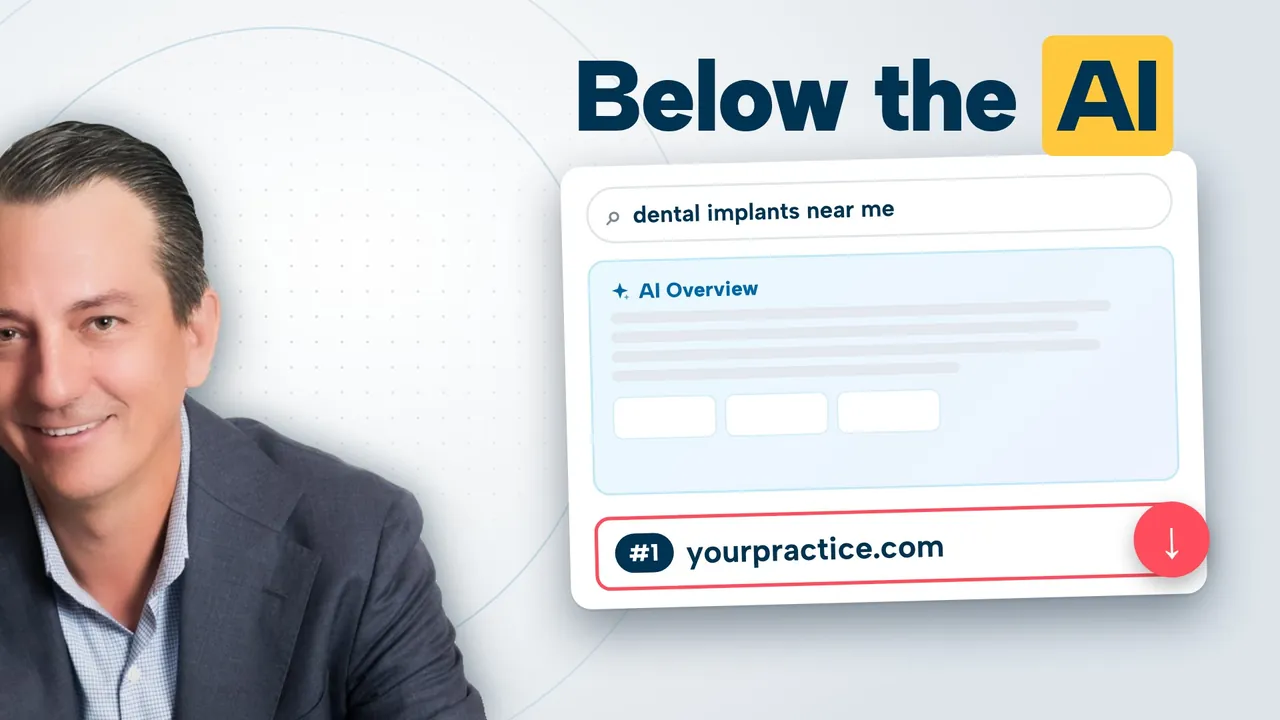
This guide explains what changed, which searches you can still win, and the step most practices skip: tracking every keyword to real production dollars so you know what is actually working. The full training is in the video below.
Video chapters (18)
- 0:00Welcome and what you will learn
- 3:44New patients arriving through ChatGPT
- 4:57How patients find a dentist today
- 6:30Google informational searches and AI Overviews
- 8:20Transactional searches: ads, Maps and rising costs
- 10:35Agentic marketing: AI books the appointment
- 15:39SEO vs AEO: walled garden vs open system
- 18:41AEO signals: reviews, structured data, PR, Reddit
- 21:29Measuring AI visibility: presence, position, impact
- 23:04Reality check: AI alone is not enough
- 25:54Revenue attribution: track every keyword to dollars
- 28:34Five things: publish original research
- 30:41Add questions and answers, even tables, to your pages
- 33:10Add an llms.txt file for AI bots
- 34:20Write a marketing plan
- 38:46Q&A: one action to take today
- 40:06Q&A: connecting call tracking to your PMS
- 42:16Q&A: SEO and AEO as a Venn diagram
Key takeaways
- About 80 percent of Google searches are informational questions, and AI Overviews now answer them above the organic listings.
- The remaining transactional searches, like "dentist near me," are fewer and more competitive, so ad clicks and Maps positions cost more.
- AI assistants are a fast-growing patient source, but AI alone will not keep your schedule full yet.
- Connect call tracking to your practice management system so every keyword ties to new patients and production dollars.
- Write a marketing plan, and treat SEO and AEO as a Venn diagram you plan together, not two budgets.
How have Google AI Overviews changed dental SEO?
Google now answers most question-style searches itself. About 80 percent of Google searches are informational, and for those Google shows an AI Overview at the top of the page, with the organic listings underneath. Patients often get their answer before they reach any practice website.
Informational searches are questions. Patients learned to search this way partly by asking ChatGPT, and Google adapted to match. Typical dental examples:
- What's the difference between an implant and a bridge?
- What does it cost to get Invisalign?
- Does tooth extraction hurt?
For queries like these, the AI Overview is what the patient reads first. Your organic listing still matters, but it now supports the AI Overview instead of being the first thing anyone sees.
If your SEO performance has declined over the last 18 months, this is the main reason we see. Your content did not suddenly get worse. More and more searches return AI Overviews, and those need to be managed differently than a classic page ranking. We show real search results in the video at 6:30.
Informational vs transactional searches: what's the difference?
An informational search is a question, like "does tooth extraction hurt?", and Google increasingly answers it with an AI Overview. A transactional search shows intent to book, like "dentist near me," and returns paid ads, a map and organic listings. Roughly 80 percent of searches are informational and 20 percent transactional.
The two types need different tactics, so it helps to see them side by side.
| Factor | Informational search | Transactional search |
|---|---|---|
| Share of Google searches | About 80 percent | About 20 percent |
| What the patient is doing | Asking a question, researching a treatment | Looking for a dentist to book with |
| Dental examples | "Implant or bridge?", "What does Invisalign cost?" | "Dentist near me" |
| Top of the results page | AI Overview, supported by organic listings | Paid ads, then the map, then organic listings |
| How you show up | Clear answers to patient questions, AEO signals, strong SEO | Google Ads, Google Business Profile and Maps, local SEO |
| What is changing | Patients get answers before visiting a website | Fewer searches, more competition, higher costs |
Put together, there are four main ways to get in front of a patient on Google today: AI Overviews, organic listings, paid ads and the map. That is what owning your area on Google looks like now, and it has changed fundamentally in the last 18 months. That is before counting the searches that have moved to ChatGPT, Gemini and Claude.
Why are dental Google Ads and Maps getting more competitive?
Transactional searches are now a smaller share of the total, so more practices compete for fewer high-intent searches. That pushes up cost per click on paid ads and makes Google Maps positions harder to hold. Many practices feel it as rising costs even when their own campaigns have not changed.
Think about what is left when most searches turn into questions answered by an AI Overview. The remaining 20 percent are the "I'm ready to book" searches, and every practice in your market wants them. The results page for those searches has three layers: paid ads at the top, the map in the middle and organic listings at the bottom.
What practices typically notice:
- Cost per click creeping up on Google Ads for the same keywords.
- Map positions shifting, with the practice showing lower or less often.
- Organic listings pushed further down, beneath the ads and the map.
This split between informational and transactional searches is the cause. And it matters more than any other channel shift, because Google is still roughly 90 percent of your traffic. See the results page breakdown at 8:20 in the video.
The practical takeaway: when every high-intent click costs more, you cannot afford to guess which keywords produce patients. That is why attribution, covered below, matters so much now.
Can AI search alone keep your schedule full?
Not yet. AI assistants are a real and fast-growing source of new patients, and those patients convert well. But in our data AI still drives only a small slice of new patient growth today, so a practice that bets everything on AI will come up short.
Here is how patients find a dentist today, based on the data we track every year:
- Word of mouth and referrals are still number one.
- Search engines and online reviews, mainly Google, have recently passed insurance provider directories as patients take more control of their own research.
- AI assistants like ChatGPT, Claude and Gemini now account for an estimated 9 to 12 percent.
Our internal tracking tells the same story. New patients coming in through the ChatGPT channel started at nothing and have grown steadily over the last year. And the conversion rates of people who come through ChatGPT are much higher than we have historically seen from SEO or Google, because they arrive more engaged and already trusting the recommendation.
The next shift is agentic: an AI agent that knows a patient's needs and calendar finds an open slot and books it. That is not happening in dental today, but we expect it within two to three years. We cover it in how patients use AI to find a dentist.
The reality check
Across our practices, AI drives roughly 1 to 5 percent of new patient growth today. Eighteen months ago it was zero. Our projection is that it reaches about 12 percent in another 18 months, and grows quickly after that. Numbers vary depending on where you look, but the direction is clear.
So do not depend on AI alone. The best performing practices run marketing as an ecosystem: an optimized website, SEO, AEO and paid ads, lead tracking and nurture for leads that do not book, review management, and revenue attribution tying it all together. We break that system down in why dental marketing isn't working.
How do you track dental marketing to revenue, not just leads?
Track every channel and every keyword to a business outcome, which for a practice means new patients and production dollars. That takes an automated connection between your marketing data and your practice management system, not a question at the front desk. Without it, you are guessing.
There is a famous line in marketing: half the money I spend on advertising is wasted, the trouble is I don't know which half. In my 25+ years in marketing, the biggest difference I have seen between enterprise marketing and local marketing is what gets measured.
It is easy to measure marketing outcomes like clicks and calls. The only business outcome that really matters is revenue production. And there is a way to track every keyword to every patient dollar it generates.
In our experience, nine out of ten doctors we talk to do not really do this. The one in ten who do usually have a back-of-the-envelope system:
- The front desk asks new patients how they heard about the practice.
- There is a "how did you find us" field on the new patient form.
That is better than nothing, but it is not attribution. An automated, platform-to-platform connection solves the problem for you, and it matters even more now that transactional clicks cost more. We explain why in the video at 25:54, and our lead tracking and analytics service is built around it.
How does dental call tracking connect to your practice management system?
Call tracking captures each caller's phone number and the marketing source behind the call. Your practice management system stores every patient's phone number. Matching the two records, keyed off the phone number, ties each new patient and their production back to the keyword or channel that brought them in.
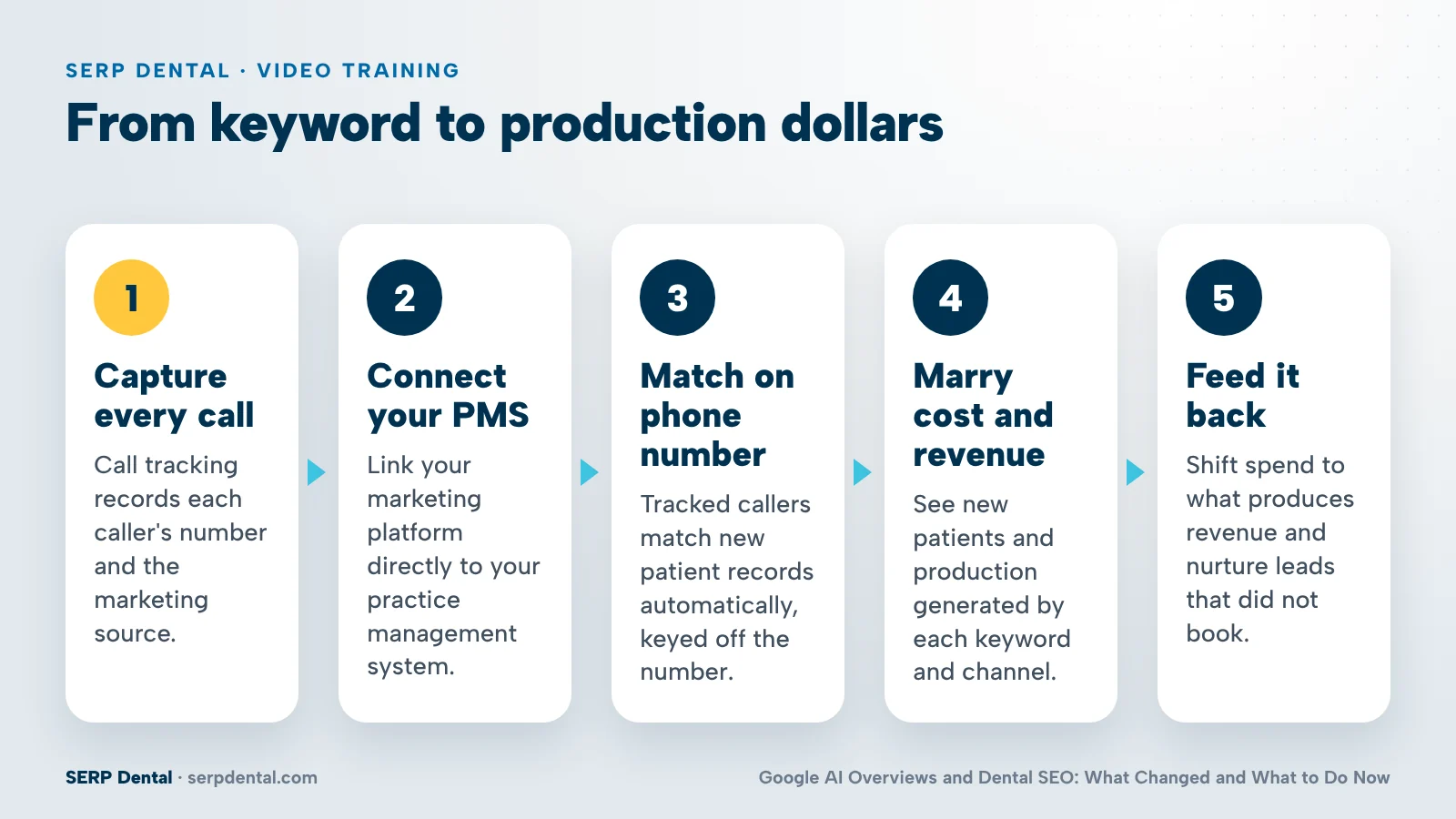
Here is how the connection works, step by step:
- Capture every call. Call tracking on your marketing records the incoming phone number and identifies where the call came from.
- Connect your PMS. A direct link between your marketing platform and your practice management system brings in patient records.
- Match on phone number. When a caller becomes a patient, their phone number in the PMS matches the tracked call automatically.
- Marry cost and revenue. Now you can see that a keyword produced this many new patients and this much new revenue.
- Feed it back. Put that data back into your marketing channels, and set up a nurture program for leads that did not book.
It is a simple integration. For us it is about a 30-minute walkthrough to connect the two systems.
Most practices already run a recall program for existing patients. Very few run one for marketing leads. Once calls and patient records are connected, you can follow up with every lead that did not turn into an appointment until it books or is closed out for another reason.
A note on privacy: the matching should happen inside your tracking and PMS platforms. If you analyze the results with an AI tool, use de-identified exports and never paste patient names or health details into public AI tools.
What should a dental marketing plan include?
A written dental marketing plan connects four pieces: your market opportunity, an audit of how you show up today, a growth forecast and a specific list of actions. Most practices execute tactics without ever writing a plan, which is the other reason they cannot tell which half of their marketing works.
Pause and write it down before adding another channel. Here is the structure we use:
| Plan component | What it covers |
|---|---|
| Market opportunity | How many dentists, employers and commuters are in your area, demographics and affluence, and where that meets your goals |
| Performance audit | Website evaluation, AEO audit and SEO audit: how you show up today |
| Growth forecast | A realistic ramp in new patients and the return on your marketing spend |
| Custom strategy | A list of specific actions that ladder up to the plan |
The forecast keeps expectations honest. You cannot go from zero new patients through marketing to 25 overnight. There is a process, and the forecast shows what each stage should return.
The strategy part is rarely one big idea. A global brand can come up with a famous tagline and spend a billion dollars. A practice wins through many small actions done well. In our audits, that list usually comes to just under 30 actions to improve visibility.
You can see a sample plan in the video at 34:20. If you want a first pass built for your market, our free strategy session covers the market analysis, AI and SEO visibility, a Google Ads review and a six-month plan.
Do you need to invest in SEO and AEO separately?
No. SEO is still critical, and SEO and AEO work like a Venn diagram. Some work benefits only SEO, some only AEO, and a lot sits in the middle and helps both. Plan them together so you are not duplicating effort or paying twice for the same work.
Do not walk away from SEO because of AI. Google still drives most of your traffic, and we believe Google will be a strong winner in the AI race, building on what it already has. Your SEO work keeps paying off as that happens.
AEO adds the signals AI engines use to decide who is a trusted source:
- Reviews across the web, not only your Google Business Profile
- Structured data that AI bots can read on your website
- PR and original research that show authority
- Expert citations, video (especially YouTube) and podcasts
- Question and answer content, including forums like Reddit
Two of the quickest wins are adding questions and answers to your treatment pages (even a table of five common questions about implants, with five answers) and adding an llms.txt file that tells AI bots what is on your site. We cover these and the other AEO wins in our guide to answer engine optimization for dentists, and the deeper differences in SEO vs AEO for dentists.
Where to start this week
Start with what you can see and measure: how Google AI Overviews answer questions about your treatments, and how you attribute new patients today. Then write a simple marketing plan and create one piece of original content. None of this requires a big budget, and it shows where your next dollar should go.
- Search your top treatments as questions on Google and look at what the AI Overview says.
- Check your attribution. If it is a question at check-in, you are in the back-of-the-envelope group.
- Ask about call tracking to PMS. Find out whether your call tracking can match calls to patient records by phone number.
- Write a one-page plan: market, audit, forecast, actions.
- Create one piece of content from your own experience, like what you have learned from the procedures you have done in a category. You can post it on your site, share it on social and turn it into a press release.
Marketing is a muscle. You do not wake up and run a marathon; you train for it. Small, measured steps each week add up.
Frequently asked questions
Do Google AI Overviews show up for "dentist near me" searches?
"Dentist near me" is a transactional search. For those, the results page we see is built around paid ads at the top, the map in the middle and organic listings below. AI Overviews are what Google returns for informational, question-style searches, like what Invisalign costs or whether an extraction hurts. That is why you need both strong answers on your pages and a solid Google Ads and Maps presence.
Why did my dental website traffic drop when my rankings look the same?
A likely reason is AI Overviews. About 80 percent of Google searches are now informational questions, and Google answers many of them with an AI Overview at the top of the page. Your organic listing may hold its position but sit below that answer, so fewer patients may scroll down to it. This shift has played out over the last 18 months.
Are patients who find a dentist through ChatGPT more likely to book?
In our data, yes. Conversion rates for people who come through ChatGPT are much higher than we have historically seen from SEO or Google search. Those patients have already asked detailed questions and arrive with a higher level of engagement and trust in the recommendation. The channel is still small, but it is growing quickly.
How long does it take to connect call tracking to a practice management system?
For us it is a simple integration, about a 30-minute walkthrough. The platform connects to your practice management system, then matches tracked phone calls to patient records using the phone number. Once that link is in place, you can see the new patients and revenue each keyword produced, without relying on patients remembering how they found you.
Is it too early for a dental practice to invest in AI visibility?
No, but keep it in proportion. In our practices AI drives roughly 1 to 5 percent of new patient growth today, up from zero 18 months ago, and we project about 12 percent in another 18 months. Start with low-cost steps that also help SEO, and keep investing in Google, reviews and tracking while the channel grows.
Keep watching
Patrick Hounsell is Co-CEO of SERP Dental, a division of AscendPoint Agency. His first job in digital marketing came before you could buy keywords on Google, and he went on to serve as CEO of a worldwide digital marketing firm. He has had a front row seat to search for more than 25 years.