

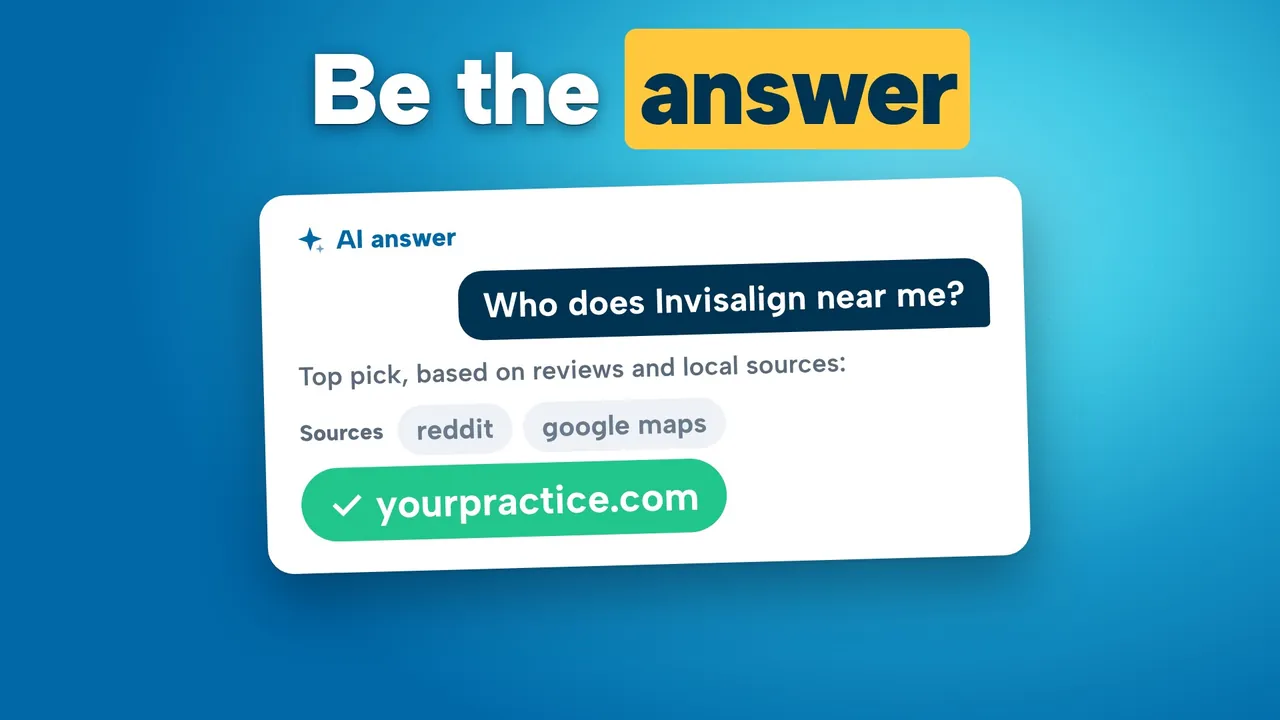
A patient types "does it hurt to get an implant?" into ChatGPT. The answer names a few practices and cites a few sources. If yours is not one of them, you never got a chance to compete. That is the problem AEO for dentists solves: SEO alone is no longer enough to be found.
In our own data, AI as a lead source started at zero about 18 months ago and has grown fast since. The estimates we work from now put roughly 9 to 12 percent of patients finding their dentist through an AI assistant.
This guide covers what answer engine optimization for dentists actually is, how to measure your AI visibility, and five wins you can work on this week, ranked from easiest to hardest. The full training is in the video below.
Video chapters (18)
- 0:00Welcome and what this session covers
- 4:32Where new dental patients come from today
- 5:42The shift from transactional to informational search
- 8:13AI as a new patient discovery channel
- 9:14The agentic future: your agent books the dentist
- 13:09SEO vs AEO: walled garden vs open system
- 15:18What AI trusts: reviews, PR, original data
- 16:24Measuring AI visibility: presence, position, impact
- 19:14Measure first: which half of your ad spend works
- 20:37Win 1: publish original research and stats
- 22:08Win 2: launch a press release
- 22:44Win 3: rewrite existing pages as questions
- 24:37Win 4: answer questions on Reddit and local forums
- 25:39Win 5: make your site AI friendly (llms.txt, robots.txt)
- 28:00What a strategy session covers
- 31:15Q&A: where should I start
- 32:24Q&A: are Google Ads still worth it
- 34:23Q&A: should dentists stop investing in SEO
Key takeaways
- About 80 percent of searches are now informational questions, and AI engines answer them before anyone sees a website.
- Measure AI visibility on three pillars: presence, position and impact across a set of real local prompts.
- Know which half of your ad spend works before adding channels; detailed source tracking comes first.
- Rewriting existing service pages to answer real patient questions is the most impactful of the five AEO wins.
- Keep investing in SEO and Google Business Profile; maps still drive roughly 30 to 40 percent of patients.
What is AEO for dentists?
AEO for dentists (answer engine optimization) is the work of making your practice the answer AI tools give when patients ask dental questions. The goal is not just to rank a page, but to be recommended, cited and mentioned by ChatGPT, Gemini, Claude, Perplexity and Google's AI Overviews.
The reason it matters is a shift in how people search. You can now split queries into two kinds.
- Informational queries ask a question: "What's the difference between an implant and a bridge?" "How much does Invisalign cost?" "Does it hurt to get a tooth extracted?" These make up about 80 percent of searches, and Google now answers many of them with an AI Overview above the organic listings.
- Transactional queries express a need to book: "dentist near me." These are about 20 percent of searches, and Google still answers them with paid ads, the map pack and organic listings.
The patient journey itself has not changed much. A patient used to Google something, visit a website, read reviews, call and book. Now they might start in ChatGPT instead, then do the same steps. The difference is that you used to worry about one place, and now you have to worry about four.
There is also a longer horizon. AI agents that already handle shopping and business tasks will eventually compare practices and book appointments on a patient's behalf. We cover that shift in how patients use AI to find a dentist. This post sticks to what you can do now: be found.
If you want the full breakdown of how Google's closed ranking system differs from the open web that AI engines draw from, read our guide to SEO vs AEO for dentists. The short version: SEO asks which page is best to show, and AEO asks which source is most trusted to answer the question.
What does AI trust when it recommends a dental practice?
AI engines look for signals that your practice is a trusted authority: reviews across many sites, press coverage, original data, demonstrated expertise and content in formats they can easily read, like video and question and answer threads. Building that entity and brand authority is the core of AEO.
Here are the sources we see feeding AI answers today:
- Reviews, more broadly than Google. Your Google reviews still matter, but AI also pulls from places like Healthgrades and Yelp.
- Structured data on your website, so machines can read who you are, where you are and what you do.
- PR, because press coverage demonstrates authority.
- Original data and research that no one else has.
- Expertise and citations from other credible sources.
- Video and podcasts, since AI can process a lot of information from them.
- Reddit and social platforms. Reddit is a message board, which means it is already in question and answer format. It is spoon fed to the engines.
The metrics change too. Instead of rankings and clicks, AEO is about mentions, citations and recommendations.
How do you measure your practice's AI visibility?
Measure AI visibility on three pillars: presence (do you show up at all), position (where you rank in the answer) and impact (whether you are recommended or just linked). Run a consistent set of real local prompts, score each answer, and you have a visibility baseline.
This is a young field, so the method needs to be simple and repeatable. When we audit a practice, we run 50 prompts in its market, such as "best implant dentist in [city]" and "best dentist in [city]," and score every answer.
| Pillar | The question it answers | What to look for |
|---|---|---|
| Presence | Did your practice show up? | How many of the prompts mention you at all |
| Position | Where did you show up? | Whether you land in the top one to five practices named |
| Impact | How were you shown? | A direct recommendation versus a passing informational link |
Together these roll up into a visibility score. It is early days, so most practices score fairly low. That is not a reason to panic. It is a reason to start now, while the bar is low.
The process is useful even before you fix anything. Seeing the actual questions people in your market ask, and which competitors AI recommends in response, tells you exactly where your content gaps are. Watch how the three pillars work at 16:24.
Measure first: know which half of your marketing works
Before adding AEO to your plan, make sure you can trace every new patient back to its source. Most practices cannot, which means they cannot tell which half of their ad spend is working. Detailed, trackable reporting back to every source is the one change we would make first, AI or not.
AI is one channel. Good marketing means running a mix of tactics and channels, then shifting budget toward what works over time. You cannot do that without measurement.
There is an old line in advertising: half the money I spend on advertising is wasted, and the trouble is I don't know which half. In our experience, that is still how most practices feel. After more than 25 years in digital marketing, including running large agencies, the most common disconnect I see is that people are not measuring the right thing.
What "measuring the right thing" means in practice:
- Every call, form and booking is tied to the source that drove it (Google Ads, Maps, organic, AI, referral).
- Revenue, not just leads, is reported back to each source.
- Decisions about budget come from that report, not from gut feel.
If you don't have this today, start with call tracking and attribution before you spend another dollar on new channels.
5 easy AEO wins for dentists, ranked easiest to hardest
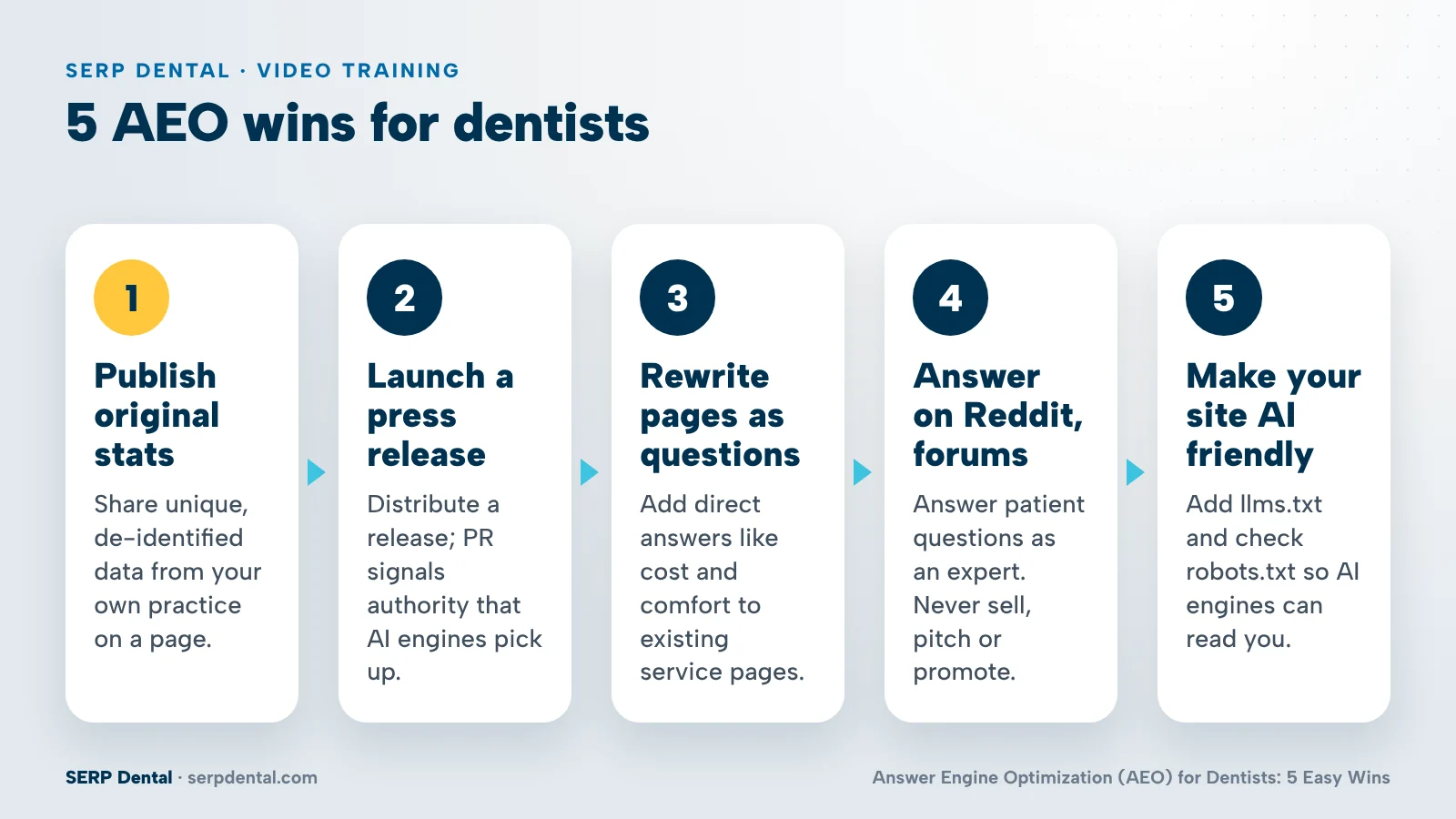
The five wins are: publish original research and statistics, launch a press release, rewrite existing pages as answers to questions, answer questions on Reddit and local forums, and make your website AI friendly with llms.txt and robots.txt. The first few you can do yourself; the last needs someone technical.
| Win | Who can do it | Why AI cares |
|---|---|---|
| 1. Publish original research and stats | You, if you have the data | Unique data tied to an authoritative source |
| 2. Launch a press release | You | PR demonstrates authority and gets picked up |
| 3. Rewrite pages as questions | You plus someone to post it | Matches the questions patients actually ask |
| 4. Answer on Reddit and local forums | You | Question and answer format AI engines read easily |
| 5. Make your site AI friendly | Someone who can check the code | Lets AI engines read your site at all |
Win 1: Publish original research and statistics
AI engines want original content tied to an authoritative source. A dentist who owns a practice sharing a statistic about an important topic is exactly that.
If you have published research in the past, resurface it. If not, you have statistics from your own practice: how many of a given procedure you have done, which issues you see most often. Get in the habit of posting them on a page you can update. Share only aggregate, de-identified numbers, and never paste patient names or health details into a public AI tool to help write it.
Win 2: Launch a press release
A press release is one of the most straightforward ways to get picked up by AI engines. You can publish one yourself through a low-cost press release distribution service. Treat it as the first step in a habit of producing content regularly, not a one-off.
Win 3: Rewrite existing pages as answers to questions
This is the most impactful of the five. Most practices have a page on implants that describes the process and why the practice is good at it. Maybe it mentions cost; usually it doesn't.
But patients are not asking "what is the process of a dental implant." They are asking "does it hurt?" and "how much does it cost?" Adding a simple paragraph that answers those questions directly, in plain language, is often all it takes.
- List the questions patients in your market are asking (your front desk hears them every day).
- Rank them by how often they come up.
- Add a short answer paragraph to the matching existing page, with the question as a subheading.
Our own tool reads a practice's site, compares it to the prompts in its market, finds the gaps and recommends this content, then adds it once reviewed and approved. See how the page rewrite works at 22:44.
Win 4: Answer questions on Reddit and local forums
Reddit can feel a little strange if you haven't spent time there, but AI engines pick it up heavily. Go on and answer questions as the professional you are. Don't sell, pitch or promote.
You are not trying to win that one patient. You are trying to be cited as the authority when that question is asked again. Local forums and community Facebook groups work the same way. As a bonus, you will see questions and worries you had not thought of, which become content ideas for Win 3.
Win 5: Make your website AI friendly (llms.txt and robots.txt)
You build a website for two audiences: patients and the engines. They speak different languages. The engines read code, including files like robots.txt and llms.txt. If that code is not on your site, they cannot read it.
If your website has not been redesigned or updated in the last 12 to 18 months, there is a very high likelihood it has no llms.txt file, which leaves it partly blind to AI engines. Creating the file is not hard; you can ask Claude to draft an llms.txt file for your site. Implementing it correctly is the part that needs someone who knows the code. Watch the llms.txt explanation at 25:39, and see our guide to getting ChatGPT to recommend your practice for the robots.txt and Google Business Profile fixes.
No single one of these is a silver bullet. AEO and SEO are death by a thousand cuts: a steady practice of finding small gaps and tending to them.
Are Google Ads still worth it for dentists with AEO?
Yes. Google Ads are still how a dental practice scales. AEO and SEO do not replace ads; they strengthen them. Google wants advertisers to have a strong AEO and SEO foundation and builds that into its algorithm, so the better you do on AEO, the better your Google Ads tend to perform.
We think of marketing as a system where the channels build on each other:
- Your website is foundational.
- AEO and SEO are foundational.
- Ads are how you start scaling.
To truly scale a practice, you have to get ads working, and you can only do that if you are tracking in detail what is actually driving performance. That brings us back to measuring first.
Should dentists stop investing in SEO?
No. Google is still the predominant digital channel for new patients, and the sources that feed Google's AI Overviews are themselves shaped by SEO. Organic listings still rank high on both informational and transactional searches, and Google Maps still drives roughly 30 to 40 percent of patients.
Look at a search results page for a dental keyword and you will see why:
- The AI Overview cites specific websites, and those sites earned their place partly through SEO.
- Organic listings still sit high on informational searches, and in some cases they are the source answering the AI Overview.
- On transactional searches, organic listings and the map pack still rank prominently.
- If you count your Google Business Profile and Maps as part of SEO, it is still critical.
AEO is an addition to SEO, not a replacement. Our guide to Google AI Overviews and dental SEO goes deeper on how informational and transactional searches play out. You can also hear the full answer at 34:23.
Where to start this week
Start with a benchmark. Find out where your practice shows up in AI answers today, how it ranks and how competitors appear, then work through the five wins in order of ease. Content changes, especially answering patient questions on existing pages, are usually the best first step.
- Run a handful of real prompts for your city and note presence, position and impact.
- Confirm you can track every new patient to its source.
- Post one original statistic from your practice.
- Add question and answer paragraphs to your top two service pages.
- Ask whoever manages your website whether you have an llms.txt file.
We are in a moment of change, and moments of change are when practices get ahead. The practices that moved early on SEO built an advantage that is still hard to break into. The same thing is happening with AI right now.
If you want a full benchmark, our free strategy session includes an AI and SEO visibility analysis across 50 local prompts, a market analysis, a technical review and a six-month plan. Or see how our dental SEO and AI ranking work handles this for you.
Frequently asked questions
How many patients find their dentist through AI tools like ChatGPT?
The estimates we work from put it at roughly 9 to 12 percent of patients today. In our own lead source data, AI started at zero about 18 months ago and has grown quickly since. Word of mouth is still the top source, but 92 percent of referred patients still check a practice's online presence.
What is an llms.txt file and does my dental website need one?
An llms.txt file is a file on your website written for AI engines, similar to how robots.txt speaks to search crawlers. If your site has not been updated in the last 12 to 18 months, it very likely does not have one. You can draft it with an AI tool, but have someone technical implement it correctly.
Should a dentist answer questions on Reddit?
Yes, if you do it as an expert rather than a marketer. AI engines pick up Reddit heavily because it is already in question and answer format. Answer patient questions helpfully, never sell or pitch, and never share anything about a specific patient. The goal is to be cited as the authority, not to win one patient.
How long does it take to see results from AEO?
There is no single switch. AEO is a long series of small fixes: content on the right pages, mentions in the right places and the right technical files. Start with a benchmark of your AI visibility so you can see movement in presence, position and impact as you work through the changes.
Do online reviews affect whether AI recommends my dental practice?
Yes. Reviews are just as important to AI as they are to Google, but AI looks more broadly. Besides your Google reviews, engines draw on sites like Healthgrades and Yelp, so a steady review generation habit across platforms supports your AI visibility.
Keep watching
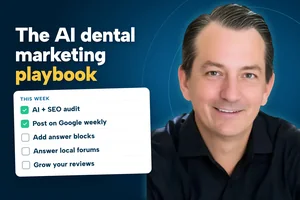
Patrick Hounsell is Co-CEO of SERP Dental, a division of AscendPoint Agency. His first job in digital marketing came before you could buy keywords on Google, and he went on to serve as CEO of a worldwide digital marketing firm. He has had a front row seat to search for more than 25 years.