

Your next patient probably will not type "dentist near me." They will ask ChatGPT, Gemini or another AI assistant a real question, get a short list of practices, check reviews and book. That shift changes how patients find a dentist, and it changes what your practice has to do to be the one AI picks.
As Savanah Carlson of MaxAssist put it when she opened this session, everyone is talking about AI, but few practices are acting on it. This guide covers the new patient journey, the coming age of AI that books appointments for patients, where AI engines get their information, how we use AI to manage Google Ads and Meta, and how to stop losing the patients you already paid to reach.
Watch the full training in the video below, or read on for the playbook.
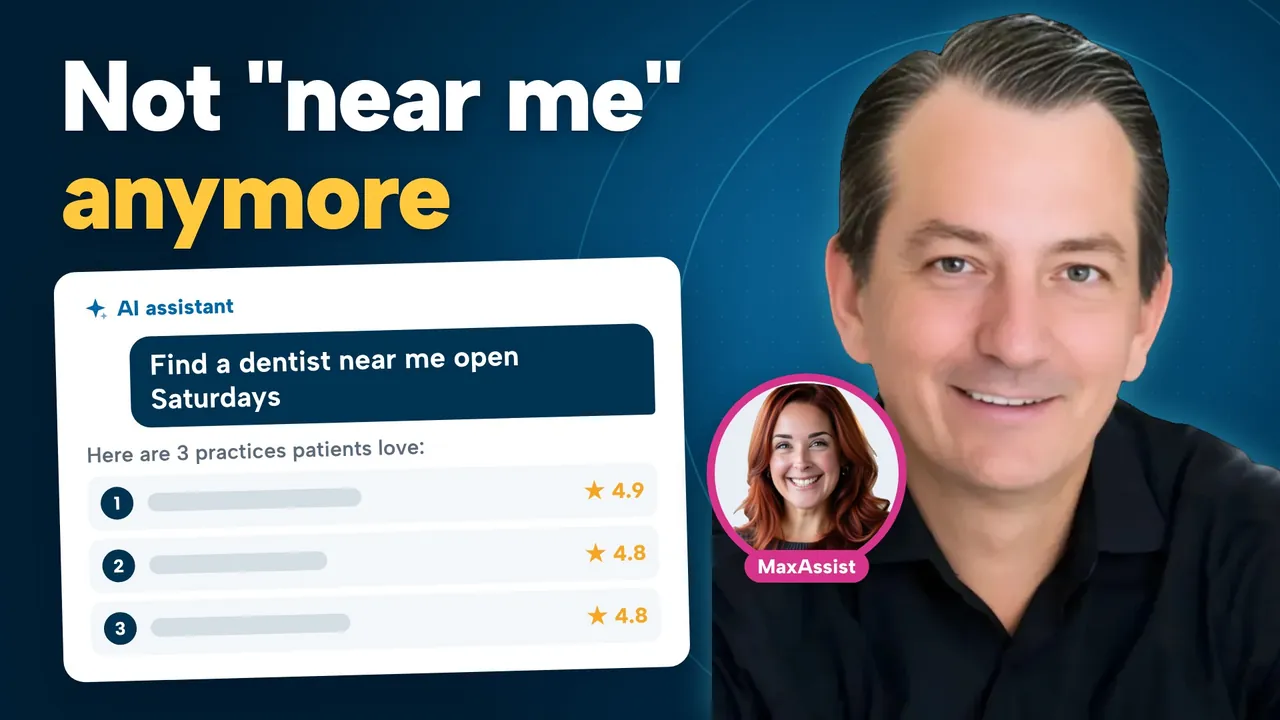
Co-hosted with Savanah Carlson of MaxAssist.
Video chapters (19)
- 0:00Welcome from Savanah Carlson of MaxAssist
- 2:33Patrick Hounsell on how AI is changing dental marketing
- 3:46Four phases of digital marketing history
- 5:12How patients choose a dentist with AI
- 8:54The agentic age: AI that books appointments
- 10:51SMILE framework: AI across the patient journey
- 12:59Website as a differentiator: find your white space
- 16:35Three ways to get found: SEO, AEO, Google Business Profile
- 18:15Q&A: where AI engines pull citations from
- 23:13Let AI bots in: check robots.txt
- 25:41Google Business Profile as your AI foundation
- 26:47Service page template: answer, FAQ table, schema
- 30:00Google Ads and Meta: using AI to manage the algorithm
- 31:49Six AI agents that manage Google Ads
- 34:24Q&A: how much to spend on Google Ads
- 37:43Conversion: missed calls, nurture and reviews
- 40:37Existing patients: unscheduled treatment with MaxAssist
- 42:37Five takeaways and The AI Patient Engine
- 47:19Q&A: AI phone answering vs a live person
Key takeaways
- Patients now ask AI a question, check reviews, visit your website, then book online or call.
- AI agents that book appointments are coming; they favor practices with reviews, authority and online scheduling.
- AI engines cite YouTube, press releases, Reddit answers and FAQ content, not just your website.
- We see at least a 30% no answer rate on calls; use AI for after hours and surge, not as a replacement.
- Your existing patients with unscheduled treatment are often your largest untapped source of revenue.
How do patients find a dentist now?
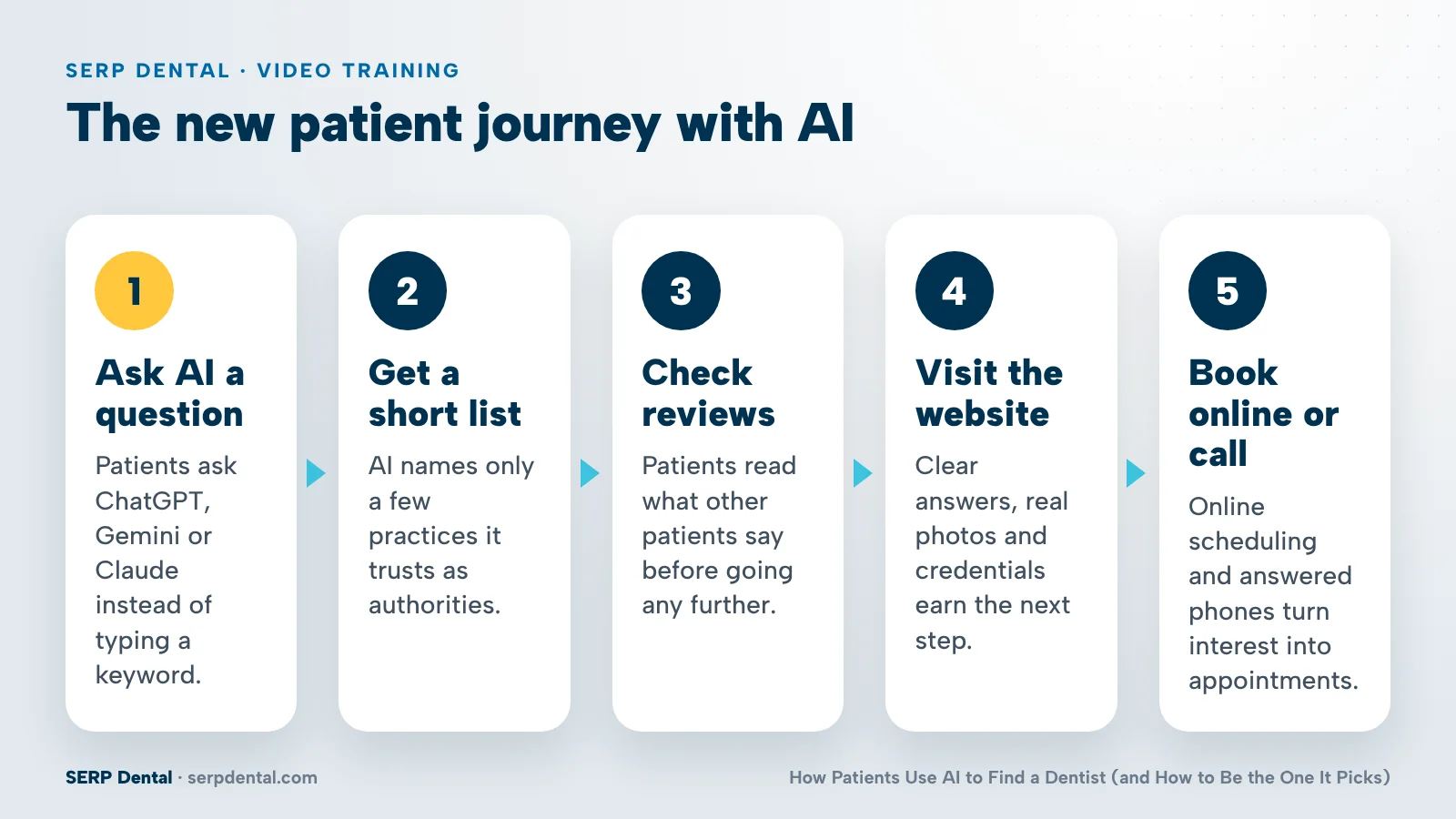
More patients now start with a question to an AI assistant instead of a keyword search. They get an answer that names a few practices, check those practices' reviews, visit a website, and then book online or call. The steps look familiar, but the first one is new.
In 25-plus years of digital marketing, I have watched four big shifts: directories, Google, Facebook and now AI. Each time, the fastest adapters won.
AI assistants are still only around the fourth most common way dentists get new patients, at an estimated 9 to 12 percent. But your own habits tell you where this is going. Industry data puts the share of people who say they have used AI to search for a doctor at about 36%.
From keywords to questions
About 80% of Google searches are now informational, where someone asks a question such as "What is the difference between an implant and a bridge?" The other 20% or so are transactional, like "dentist near me," where ads, the map listings and organic results still do the work.
Asking a question is a different behavior, so it needs a different way to engage. The new journey:
- The patient asks an AI assistant a question.
- The AI answers and names a few practices.
- The patient checks those practices' reviews.
- The patient visits the websites that pass the review check.
- The patient books online or calls.
Why AI-referred patients are worth more
Patients who come in through AI trust the dentist they chose more. AI gives fewer choices and feels personal, so people commit faster. Meta, by contrast, is often a shopping channel rather than a buying channel.
Will AI start booking dental appointments for patients?
Yes, it is starting. In what is called the agentic age, a patient asks an AI assistant to find a dentist and complete the booking. Early testing shows these agents look for practices with reviews, authority and online scheduling, because they need to finish the transaction.
Agentic means agent to agent. It is already common in commerce and is coming to service providers. A patient types something like:
Find the best implant dentist within 20 miles. I have a PPO plan. I want sedation. I can spend up to $6,000.
The agent then makes the appointment. In September, Meta launched an app that lets you try this today. I have been testing it for about a month; my booking attempts ran into problems, so it is early, but it is moving fast. You can see the agentic age section at 8:54 in the video above.
What the agent looked for tells you how to prepare:
- Reviews from real patients.
- Authority, meaning clear proof of who you are and what you do.
- Online scheduling, so the agent can complete the booking without a phone call.
Where do AI engines get information about your practice?
AI engines pull from across the open web, not only your website. They give weight to YouTube videos, press releases, Reddit and other question-and-answer boards, and FAQ content that directly answers a patient's question. Being mentioned and cited in many trusted places is what makes AI treat you as an authority.
Savanah asked this during the session, recalling that when she ran a practice, website work meant tags and keyword-optimized pages. AI works differently.
Think of SEO as a walled garden. Google curates it and rewards pages that load fast, earn links and genuinely answer the search. AEO (answer engine optimization) is an open ecosystem built to find the best answer wherever it lives. We compare the two in detail in SEO vs AEO for dentists. SEO still drives about 80% of your traffic. SEO is the present; AEO is the future.
| Source | Why AI trusts it | What to do |
|---|---|---|
| YouTube | It is in the dentist's own voice, which signals authorship and authority | Answer common patient questions on camera |
| Press releases | A validated third party is vouching for you | Announce real news through a press release distribution service |
| Reddit and message boards | The format is already a question plus an answer from someone credible | Answer questions helpfully; never sell |
| FAQs on your site | A direct answer is the least work for the engine | Add FAQs with structured data to service pages |
| Original data | Only you could know it, so it reads as authority | Share how many of a procedure you have done and what you have learned |
What should a dental service page look like for AI?
An AI-ready service page answers what the treatment is, how much it costs and how long it takes in the first three sentences, credits the dentist who stands behind it, breaks the rest into patient questions, and ends with a machine-readable FAQ table marked up with schema, plus real proof like reviews.
A website has two readers: the patient and the bot. If your site was built more than about six months ago, your service pages were probably written for the old SEO model. Here is the shift, using an implant page as the example.
| Old service page | AI-ready service page |
|---|---|
| Long explanation of the procedure | A direct answer in the first three sentences: what it is, how much, how long |
| Written from the provider's point of view | Written from the patient's point of view and credited to the dentist |
| Keyword-filled paragraphs | Headers phrased as questions: How much does it cost? Does it hurt? Am I a candidate? |
| No structured data | An FAQ table with schema that AI can lift straight into an answer |
| Stock photos | Real photos, reviews and credentials |
Machines, like people, want to do the least work possible: serve up a question with an answer and the engine knows what to grab. The side-by-side page comparison starts at 26:47.
Give each service its own page so your authority on it is clear. AI bots also need to be able to read your site at all; we cover the robots.txt check and the rest of the website fixes in how to get ChatGPT to recommend your dental practice.
How can AI manage your Google Ads and Meta campaigns?
Google and Meta use AI to spend your budget in the way that earns them the most clicks. To protect your budget, you need AI of your own watching every campaign, pausing waste as it happens and finding where to scale. We run six AI agents that do exactly that across our client accounts.
We hear two complaints from dentists: Google Ads got too expensive, and Meta brings people who book but do not show up.
I will say it plainly: your job in Google pay-per-click is to fight Google. The market is mature, clicks are expensive and Google keeps automating more. You have to find where it is spending your money too quickly and give it rails.
Four of the agents we use
| Agent | What it does |
|---|---|
| Campaign builder | Reviews all our campaigns so a new practice starts with campaigns we know work |
| Monitoring | Watches every campaign and triggers instantly, for example pausing the keyword behind a wrong-number call |
| Performance | Runs deep periodic evaluations and flags anomalies |
| Scaling | Watches share of voice in your market and shifts budget where competitors are pulling back |
The monitoring agent is the most important. Wrong numbers are the bane of dental PPC, because Google wants to show your ad to as many people as possible. We track every call, so the moment a wrong-number call comes in, the agent finds the keyword and pauses it. A human cannot do that efficiently. See the six agents at 31:49.
The agents learn from a master account holding all our historical dental campaigns, then look for opportunities in your account, without sharing your confidential data. For competitive context we usually start with a five-mile radius (in Manhattan, it might be a block). These tools show share of voice, not competitor spend.
How much should a dental practice spend on Google Ads?
It depends on your market. We recommend $2,000 to get started, which is enough to see what is working. In big metro areas like New York or Los Angeles, plan on $5,000 to $10,000. Once you see a two-to-one or three-to-one return, spend as much as you can until that return drops.
Your agency may have said you are not performing because you are not spending enough. It sounds convenient, but Google does give preference to bigger budgets.
The point of a starting budget is insight. With $2,000 you learn where to play. Then you scale what returns two or three dollars per dollar spent, until it stops. That is the job our scaling agent does. See how we run dental Google Ads management.
Why are you losing patients who already called?
Because many calls never get answered. Across all of our clients we see at least a 30% no answer rate. Add callers who never book and a weak review process, and much of your ad budget leaks out between the first call and treatment acceptance. AI can close most of those gaps.
With today's technology, you should not miss a single call. Here is where we point AI:
- Answer every call. Use AI for after-hours and busy-time coverage so no call goes unanswered.
- Record and grade every call. Not to judge your team, but to give your front desk specific coaching tips.
- Nurture the callers who did not book. Point your nurture campaign at people who called but did not schedule, not only at existing patients.
- Automate review requests. Then make sure the right person asks.
If you use public AI tools to review calls or lists, work from de-identified exports and never paste patient names or health details into them.
Should AI or a person answer your phones?
A person handles a call better. But patients call after hours and when your team is busy. Our client base averages about a 32% unanswered rate, and I heard figures around 39% at an industry conference. It should be zero. Use an AI answering agent for surge and after-hours calls, not as a replacement, so every caller is at least handled and routed.
Measure revenue, not just calls
| Channel A | Channel B | |
|---|---|---|
| Cost per call | $20 | $50 |
| Revenue per call | $1,000 | $5,000 |
| Where the money should go | Looks cheaper | Actually the better investment |
Tracking the call is not the same as tracking production. It is the number one thing to fix, and it costs nothing. Our call tracking and attribution work is built around this.
How much revenue is already sitting inside your practice?
Usually more than you think. Patients with diagnosed but unscheduled treatment, and patients overdue for recall, have already trusted your team. Most practices do not know the size of that opportunity. AI can show exactly who needs attention so your team can follow a consistent process to bring them back.
Savanah Carlson of MaxAssist made this point from the practice management side. We naturally think of growth as acquisition, but her question for every practice is: what opportunity is already sitting inside it?
In an illustrative AI snapshot she shared, 873 existing patients had unscheduled treatment, representing nearly $1.4 million in diagnosed treatment. These patients have been in the chair and had the conversation with the doctor and team. You will not schedule all of it tomorrow, but it shows that your patient database is an asset.
AI moves your team from "we should probably work our unscheduled list" to knowing exactly who needs attention. MaxAssist is built for that work: finding scheduling gaps, reactivating overdue patients and recovering unscheduled treatment. Savanah walks through it at 40:37.
Think about growth in both directions: new patients in, and care for the relationships you have already earned. We lay out how both fit together in our AI dental marketing playbook, built around the SMILE system.
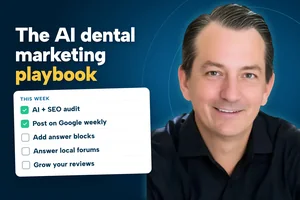
Where to start this week
Start with five moves: review your marketing strategy, manage your Google Business Profile actively, add AI-ready content like FAQs to your key pages, engage your existing patients, and keep asking for reviews. None of these needs a new website, and each one makes you easier for AI and patients to choose.
- Review your strategy. Marketing fails when you have no strategy, the wrong strategy or the wrong measurements. Having no strategy is the biggest problem.
- Manage your Google Business Profile actively. Schedule ChatGPT or Claude to draft three Google Business Profile posts every Monday morning, then review and post them.
- Create AI content. Look at your key pages and ask where an FAQ would help, without rebuilding your whole site. Start collecting original statistics from your office.
- Engage existing patients. Reactivate overdue patients, start a newsletter and find local partners. They matter as much as new patients.
- Keep focusing on reviews. The biggest lever is simply asking. As an old boss of mine used to say, it is not the how, it is the who. Find the person on your team who is good at asking, and make sure they ask.
My upcoming book, The AI Patient Engine, goes through the SMILE system in much more detail. The best time to start with AI was three years ago. The next best time is today; start now and in 18 months you can be dominating your area.
Want a second set of eyes? Book a free strategy session and we will audit your current visibility and process.
Frequently asked questions
Do patients really use ChatGPT to choose a dentist?
A growing share do. AI assistants are still only around the fourth most common source of new patients, at an estimated 9 to 12 percent, but industry data shows about 36% of people say they have used AI to search for a doctor. Patients who arrive through AI also tend to trust their choice more and act on it faster.
Does online scheduling help a dental practice show up in AI?
It helps with AI agents that book on a patient's behalf. In early testing of an AI booking app, the agent looked for practices with reviews, authority and online scheduling, because it needed to complete the transaction. If a patient's agent cannot book you online, it has a reason to choose another practice.
Should a dentist post on Reddit to get recommended by AI?
Answering questions on Reddit and other message boards can help, because the format is already a question plus a credible answer, which AI engines value. The rule is to never sell. Answer patient questions helpfully and consistently, and the engines start to see you as an authority on those topics.
Is SEO still worth paying for if patients are using AI?
Yes. SEO still drives about 80% of your traffic, so it remains the present while AEO is the future. The two share many of the same foundations, such as a strong Google Business Profile, clear service pages and reviews, so work on one usually supports the other.
What is the fastest way to stop losing new patient calls?
Make sure every call gets answered. We see at least a 30% no answer rate across our clients. Keep your team on the phones during the day, add an AI answering agent for after hours and busy periods, record and grade calls for coaching, and send a nurture sequence to callers who did not book.
Keep watching
Patrick Hounsell is Co-CEO of SERP Dental, a division of AscendPoint Agency. His first job in digital marketing came before you could buy keywords on Google, and he went on to serve as CEO of a worldwide digital marketing firm. He has had a front row seat to search for more than 25 years.