

Patients are still asking friends for a dentist and still searching Google. But a growing share now ask ChatGPT, Gemini or Claude, and then check what those answers say before they ever call. AI dental marketing is not a separate project for later. It already touches how patients find you, whether they book and whether they come back.
The good news: most of what moves the needle is not complicated, and a lot of it you can do yourself. I have spent 25+ years in digital marketing, including running large enterprise agencies, and every major shift I have seen created room for new players to take market share.
This playbook walks through the SMILE system we use with practices, a quick way to assess where you stand, how AI fixes the leaks between a phone call and completed treatment, and five things you can start this week without hiring anyone. The full training is in the video below.
Video chapters (19)
- 0:00Welcome and what you will learn
- 2:48AI as the new platform: attract, convert, retain
- 5:52Agentic AI: your next patient's agent books you
- 8:40Early results: AI as a new patient channel
- 10:15How patients choose a dentist now
- 11:17Informational vs transactional Google searches
- 14:00SEO walled garden vs AEO open system
- 16:31Building AI authority: reviews, PR, Reddit
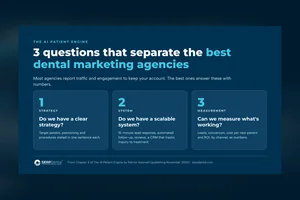
- 18:19Why dental marketing fails: strategy, system, measurement
- 20:23The SMILE system and a self assessment
- 23:23Intelligent conversion: missed calls and call grading
- 26:38Link every dollar: cost per call vs production
- 28:27Engage and remarket: unaccepted treatment
- 31:43Step 1: get informed with an AI and SEO audit
- 32:53Step 2: post weekly and fill every Google Business Profile field
- 33:59Step 3: add answer blocks to your key pages
- 35:22Step 4: answer questions in local forums and Reddit
- 36:56Step 5: grow your reviews
- 39:38Q&A: the first step to take today
Key takeaways
- AI engines already account for about 9 to 12 percent of how patients choose a dentist, behind referrals, search and insurance directories.
- SMILE stands for Stand out, Market everywhere, Intelligent conversion, Link every dollar, and Engage and remarket.
- Across our client base about 30% of calls go unanswered. AI phone assistance can close that gap.
- Judge channels by production, not cost per call. A $50 call can be worth far more than a $20 call.
- This week: get an audit, complete your Google Business Profile, add answer blocks, join local forums and grow reviews.
What does AI dental marketing actually change for a practice?
AI dental marketing uses AI at every stage of the patient journey: to attract new patients through AI engines as well as Google, to convert more callers into booked patients, and to retain more of the revenue you have already earned. Think of AI as electricity, and each tool as something you plug into it.
The old digital path was a Google search, a few websites, reviews, a call and a booking. Now AI shows up at almost every step.
- Attract: patients discover practices through ChatGPT, Gemini, Claude and other AI platforms, not only through Google.
- Convert: AI voice and phone assistants, online scheduling and call grading help more lookers become patients.
- Retain: automated nurture, review collection and remarketing keep revenue from slipping away.
We have tracked AI as a new patient source since Q1 of 2025, and new patient leads from AI engines keep growing. Referrals and word of mouth still come first, then search engines, then insurance directories. AI is now fourth, at about 9 to 12 percent of how patients select a dentist. Even referred patients go online to validate the recommendation.
Google still drives a majority of new patients, but its results have split between informational and transactional searches; see Google AI Overviews and dental SEO.
Being found in AI is not the same job as ranking on Google. SEO is about ranking pages; AEO (answer engine optimization) is about being recommended, and we break down the difference in SEO vs AEO for dentists. Further out, agentic AI will let a patient's own assistant compare practices and book the appointment for them, which we cover in how patients use AI to find a dentist.
What is the SMILE system for dental marketing?
SMILE is SERP Dental's marketing system, built on five pillars: Stand out, Market everywhere, Intelligent conversion, Link every dollar, and Engage and remarket. Each pillar has an AI angle, and together they cover the full path from first impression to completed treatment and repeat visits.
It exists because most practices where marketing has not worked share the same gaps: no clear strategy for their market, no system of scalable processes and tools, and little or no measurement. We go deeper on those gaps in why dental marketing isn't working. SMILE is how we close them.
| Letter | Pillar | What it means in practice |
|---|---|---|
| S | Stand out | A website, mobile site, Google Business Profile, reviews and social presence that reflect your brand and make it easy to engage |
| M | Market everywhere | Every channel working, with different ones optimized at different times for your market |
| I | Intelligent conversion | AI tools that remove friction between a lead and completed treatment |
| L | Link every dollar | Every marketing dollar connected to production and revenue, not just calls |
| E | Engage and remarket | Existing patients, lapsed patients and unaccepted treatment treated as a revenue source |
S: Stand out
Practices invest heavily in the office, because that is where patients experience the brand. They forget that the website, mobile site and social presence are part of that experience too.
If you are spending thousands of dollars repainting the office or buying a new couch and artwork for the waiting room, but your website is four years old, rethink the split. Put that money into a fast, modern website that reflects who you are.
M: Market everywhere
Every market is unique, so marketing is unique in every market. A practice with a competitor across the street will see channels perform differently than a practice in a less crowded area.
There is no silver bullet. If you could write hit songs on demand, you would. Have all channels working, then test and learn your way to the right mix, and keep adjusting as your market changes.
The next three pillars are where AI does the most work. Watch the SMILE walkthrough at 20:23 in the video above.
How do you know where your dental marketing plan stands?
Start with an honest self-assessment across strategy, system and measurement, the three areas where we see practices fall short most often. Our self-assessment tool scores you on these parameters so you can see which gap to close first before you spend another dollar on tactics.
Before you take it, ask yourself these questions. Wherever you hesitate, start there.
| Area | Ask yourself |
|---|---|
| Strategy | Do we have a clear roadmap and a defined target audience? If there are 10 practices in our market, do we know how we compete against them? |
| System | Do we run on scalable processes, tools and automated workflows, or does everything depend on someone remembering? |
| Measurement | Do we track key performance indicators all the way to revenue, or only clicks and calls? |
How does AI help convert more calls into patients?
Intelligent conversion uses AI to remove the roadblocks between a lead and completed treatment. The biggest are unanswered calls, uneven phone skills, no-shows and cancellations, and unaccepted treatment. Fixing them grows your results without buying a single extra lead.
Marketing brings in the leads, and nine out of ten of them will call. That is where the leaks start.
Missed calls
Across our client base, we see about 30% of calls go unanswered. That is 30% of your opportunity lost before anyone at the front desk says hello. AI voice and phone assistants can take that from 30% unanswered to 0%, which improves your marketing ROI by at least 30% because the pool of real opportunities stays bigger.
Call grading
When callers do get through, phone skills vary. We record and listen to every call for our clients, and there is always a spectrum of quality. AI phone grading records the call, listens and gives coaching. Over time your team gets better and loses fewer callers.
No-shows, cancellations and callers who did not book
Most practices already use AI nurture tools for patients who have an appointment. Use them for people who called but did not book, too. Start a nurture stream instead of letting the lead go cold.
Treatment acceptance and reviews
Membership plans help. Through our relationship with Plan Forward, we can see that when a membership plan is available, patients are more likely to go ahead with treatment. Once treatment is complete, use AI automated review requests so every happy patient has an easy way to say so.
Fixing these leaks starts with seeing them, which is why call tracking and recording sit at the center of our lead tracking and analytics work. See the full value chain at 23:23.
Why is cost per call the wrong way to judge your marketing?
Cost per call ignores what each call is worth. Link every dollar means connecting your marketing spend to production and revenue, so you fund the channels that bring in valuable patients, not just the cheapest calls. It is the single most important thing in the SMILE system.
Here is the math. Two practices each spend a $1,000 budget.
| Practice A | Practice B | |
|---|---|---|
| Budget | $1,000 | $1,000 |
| Cost per call | $20 | $50 |
| Calls | 50 | 20 |
| Production generated | $1,000 | $5,000 |
Most agencies report cost per call, and on that number alone you would pour money into Practice A's channel. But Practice B produced five times as much from the same budget. If you cannot connect budget to revenue, you make the wrong optimization decision.
You would not practice dentistry without the right equipment. Practicing marketing without this kind of tracking is malpractice. If you do not know how every marketing dollar turns into production, fix that first.
How much revenue is sitting in unaccepted treatment?
Usually more than practices expect. Engage and remarket means going back to your existing patients first: lapsed patients and patients with unscheduled treatment plans. That revenue is already sitting in your practice management system.
Through our partnership with MaxAssist, we can run a free analysis that shows how much unaccepted treatment and how many lapsed patients exist in your practice today. In one illustrative example, the analysis found 783 patients with unscheduled treatment plans sitting in the system, worth $1.4 million.
Once you see that number, you can build a strategy to bring those patients back.
The analysis needs a sync to your PMS, which takes about a five-minute conversation to set up. If you analyze patient data with AI tools yourself, work from de-identified exports and never paste patient names or health details into public AI tools.
5 AI dental marketing steps you can take this week
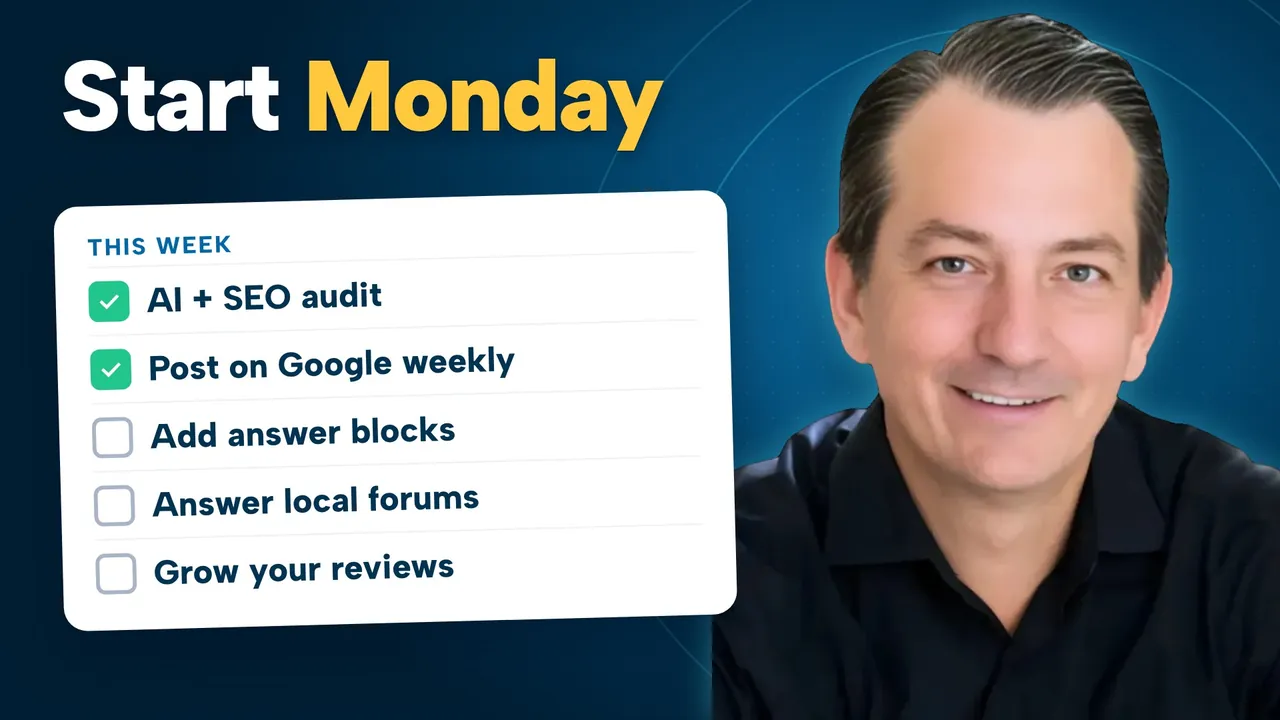
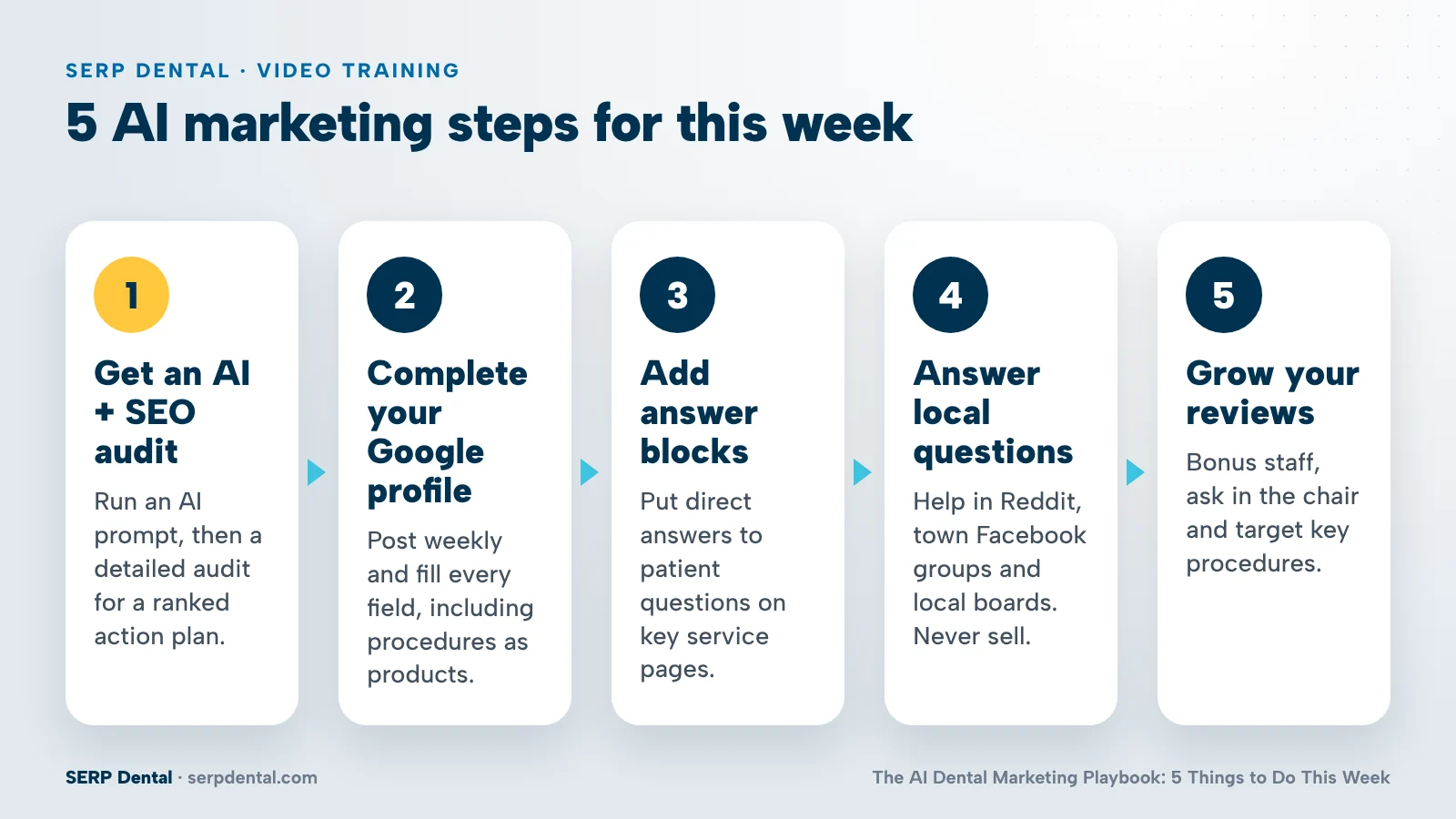
You can do most of this yourself, this week, without an agency: get an AI and SEO audit, complete and update your Google Business Profile, add answer blocks to key pages, answer questions in local forums and Reddit, and grow your reviews. Each one tells AI engines you are an active, trusted practice.
1. Get informed with an AI and SEO audit
Start by learning where you stand. Ask an AI tool to review your website and online presence for a quick first read. You still need a human expert to judge it: when we check these AI answers, we agree with about 80% of what they say. Our copy-paste versions are in ChatGPT prompts for dentists.
For a detailed baseline, our system runs about a forty point analysis covering your Google Business Profile, AI visibility, a site audit, page speed and schema on your pages, then turns it into an action plan. In one AI visibility audit of a practice, the plan had 19 action items: 2 critical and 17 important, such as adding person schema and service schema.
2. Post weekly and fill every Google Business Profile field
Manage your Google Business Profile actively. Post a photo or video every week if you can, and never let it go more than two weeks. Google and the AI engines care less about the content than about the activity.
Then check that every field is complete. Two we often see missing:
- Products: in dentistry you can list your services and procedures as products. Many practices leave this empty.
- Location details: make sure your location information is filled in.
SEO is death by a thousand cuts. You have to do a thousand small things well, and this is one of the easiest.
3. Add answer blocks to your key pages
AI engines look for authority and for questions with clear answers. Go through your most important pages and ask: is there a question a patient has here that the page never answers directly?
If implants matter to your practice, open your implant page and look for the missing answer. Add a short, direct answer block. Our audit flags pages missing one, but you can eyeball it yourself, and it does a lot for AI visibility.
4. Answer questions in local forums and Reddit
Message boards matter for AI because they are already in question and answer format: someone asks, others answer, and AI engines learn from both. Reddit gets picked up a lot, although recent news suggests it is being picked up less.
If not Reddit, use any community board: your town's Facebook group, your Chamber of Commerce discussion board, anywhere locals ask questions. Don't sell and don't promote yourself. When someone asks "I was told I need a tooth extraction, does it hurt?", answer with data and facts. Those answers get picked up.
Offline counts too. Try to get interviewed by your local newspaper or publication; a seasonal angle like Halloween is an easy way in.
5. Grow your reviews
Reviews feed both SEO and AI trust. The tactics we have seen work:
- Bonus your staff for reviews they help collect.
- Ask in the chair, while the patient is still with you.
- Target key procedures, so reviews mention the treatments you want to be known for, like implants.
| Step | What to do | Why it matters for AI |
|---|---|---|
| 1. Get informed | Run an AI prompt, then a detailed AI + SEO audit | Gives you a baseline and a ranked action plan |
| 2. Google Business Profile | Post weekly, complete every field, list procedures as products | Engines reward activity and completeness |
| 3. Answer blocks | Add direct answers to key service pages | AI looks for clear questions and answers |
| 4. Local forums | Answer questions in Reddit, Facebook groups and local boards | Q&A content is easy for AI to learn from |
| 5. Reviews | Staff bonuses, ask in the chair, target key procedures | Reviews build trust for both SEO and AEO |
Where to start this week
If you only do one thing today, run a quick AI prompt about your website and online presence. It takes minutes, and it shows you where you stand. Then begin turning key content on your website into questions and answers, which is a longer project that pays off with every engine.
Most issues an audit finds are small cuts, but a few can be serious. When I checked a site in my neighborhood, it had been hijacked: the code behind it was not theirs.
If you want the detailed version, our free strategy session covers a market analysis, a full AEO and SEO analysis, a Google Ads review if you want one, a website technical review and a six-month marketing plan. Book a strategy session, or jump to the Q&A at 39:38 for the first step to take today.
Frequently asked questions
Can a dental practice do AI marketing without an agency?
Yes, much of it. You can run an AI prompt on your own website, keep your Google Business Profile active and complete, add direct answer blocks to key pages, answer patient questions in local forums and ask for reviews in the chair. An agency helps most with detailed audits, call tracking and connecting spend to production.
How often should a dentist post on Google Business Profile?
Aim for a new photo or video every week, and never let it go more than two weeks. Google and AI engines care less about what you post than about seeing regular activity. Also complete every field, including listing your services and procedures as products, which many practices leave empty.
Should my dental office use an AI phone assistant?
If calls go unanswered, it is worth a look. Across our client base about 30% of calls go unanswered, and AI voice and phone assistants can bring that toward 0%, improving marketing ROI by at least 30%. Pair it with call grading so the calls your team does answer get better over time.
Is Reddit still worth it for dental practices?
It can be. Reddit gets picked up a lot by AI engines, though recent news suggests less than before. The bigger point is any local Q&A space: town Facebook groups, Chamber of Commerce boards and similar forums. Answer questions with facts, never sell, and those answers can be picked up by AI.
What is AI call grading for dental offices?
AI call grading records front desk calls, listens to them and gives coaching on how each call was handled. Phone skills vary from person to person, so consistent feedback helps your team book more callers and lose fewer of the leads your marketing already paid for.
Keep watching
Patrick Hounsell is Co-CEO of SERP Dental, a division of AscendPoint Agency. His first job in digital marketing came before you could buy keywords on Google, and he went on to serve as CEO of a worldwide digital marketing firm. He has had a front row seat to search for more than 25 years.