

Your next patient already read your reviews. Before they call or visit your website, they look at your Google Business Profile, scan the stars and read what people say. That is why knowing how to get more Google reviews for your dental practice is one of the highest-value skills your team can build.
In our live training, Sonia Hounsell, Co-CEO of SERP Dental, walked through the whole playbook: why reviews matter so much right now, who should ask and when, the exact words to use, the rules you cannot break, and how to answer every review (even the bad ones) without a HIPAA problem. The full session is below, and the article covers every step.
Video chapters (20)
- 0:00Why reviews are the top signal
- 0:33Meet Sonia Hounsell
- 3:32Today's agenda
- 4:01Why reviews matter: Google, patients, AI
- 5:27How Google ranks your profile
- 6:41The trust bar is rising
- 8:04Reviews build your AI authority
- 10:14The review flywheel
- 12:39The rules: Google, FTC and HIPAA
- 15:15Who asks: reviews are a team sport
- 17:53When to ask: the 1 to 2 hour window
- 19:22Scripts and text templates
- 21:01Get your Google review link
- 23:07Consistency beats bursts
- 24:17Recency and richer reviews
- 25:44Automate the ask
- 27:05Respond to every review
- 28:42Handling negative reviews
- 30:235 things to do tomorrow
- 32:28Q&A: review count, team rewards, asking again
Key takeaways
- Reviews are the strongest Google Business Profile signal you control: count, rating, recency, keywords and replies.
- Almost half of people will not use a business with fewer than 20 reviews, so treat 20 as the floor.
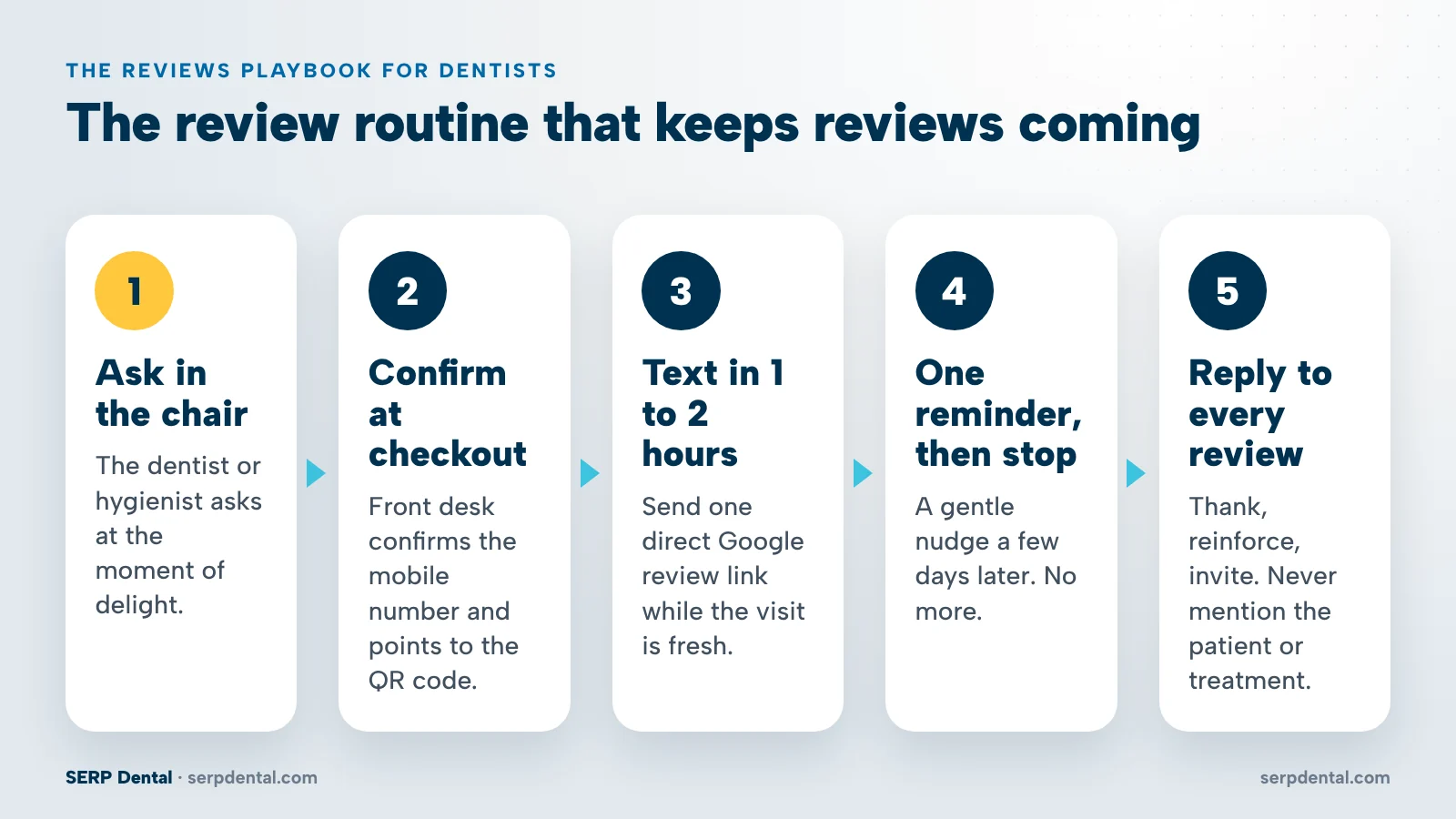
- Ask in the chair, confirm the mobile number at checkout, and text the review link 1 to 2 hours later.
- Ask every patient the same way. Never pay, filter or fake reviews.
- Reply to every review: thank, reinforce, invite. Never mention the patient or their treatment.
Why do Google reviews matter so much for a dental practice?
Reviews shape three things at once: where you rank in Google's map pack, whether a patient trusts you enough to call, and what AI tools say when someone asks for a dentist. Review count, star rating, recency, the words patients use and your replies all feed Google's prominence factor, the part of local ranking you can actually influence.
When someone searches for a dentist near them, Google weighs three factors: relevance (does what you offer match the search), distance (how close you are) and prominence (how well known and trusted you are). You cannot move your office closer to every patient. You can move prominence, and reviews are the biggest lever inside it.
| Prominence signal | What it means for your practice |
|---|---|
| Review count | More reviews build trust, and 20 is the minimum patients expect |
| Star rating | Patients filter by it before they read a word |
| Recency and velocity | How often new reviews arrive |
| Keywords in the review text | Words like implants or Invisalign build authority for those services |
| Your responses | Replies show you are active and that you care |
Patients behave the same way. Almost all consumers read reviews, and 41% say they always do. About half go to your website after reading them; the rest call or book straight from the profile. Watch Sonia explain the patient journey.
How many Google reviews does a dental practice need?
At least 20. Almost half of people will not use a business with fewer than 20 reviews, so below that line you lose patients before they read a single word. Past 20, your real target is set by your local competitors: look at the review counts of the practices you compete with and have your team work toward beating them.
The trust bar is rising fast. Sonia shared BrightLocal's 2026 consumer survey numbers:
- More than two-thirds of people now want at least 4 stars (last year it was a little more than half).
- 30% now want at least 4.5 stars, up from 17% a year earlier.
- 92% say star ratings factor into their decision.
- 56% want consistency: reviews that say the same good things.
In the Q&A, an attendee asked how many reviews it takes to rank. The answer: it varies by market. Twenty makes you look legitimate; your competitors set the real goal.
How do reviews affect AI search and ChatGPT answers?
AI tools answer "who is the best dentist near me" with what is written about you online, and reviews are rich input: they name the doctor, the treatment and how the patient felt. Fresh, detailed, consistent reviews teach AI what you are known for and that you are active, which raises your odds of being recommended.
Just 6% of people used AI for local recommendations a year ago; now almost half do. About 80% use the AI-generated review summaries Google now shows automatically. That is why this is called answer engine optimization: patients ask a question, AI gives an answer built from what is available, and reviews are a big part of it. For the full picture, read our guide to answer engine optimization for dentists and how patients use AI to find a dentist.
Reviews also pay off beyond rankings. Sonia calls it a flywheel: more reviews, higher rankings, more visibility in search and AI, more calls, more happy patients, more reviews. Along the way they ease case acceptance (patients arrive already trusting you), make Google Ads work harder, and help you hire and keep staff, who read your reviews too.
What are the rules for asking patients for reviews?
Ask every patient, ask the same way, and never pay, filter or fake. Google bans incentives, review gating (only asking happy patients) and reviews from staff or family. The FTC rule bans fake and AI-written reviews, incentives and hiding negative reviews. HIPAA means your replies never confirm someone is a patient or mention treatment.
| Source | The rule |
|---|---|
| Google policy | No discounts, gifts or drawings for reviews. No review gating. No reviews from staff, family or the owner. |
| FTC rule (2024) | No fake or AI-written reviews. No incentives. No suppressing or hiding negative reviews. |
| HIPAA | Never use the patient's name or mention treatment in a reply. Keep replies general. Train everyone who replies. |
AI is fine for helping you write replies. It is not fine for writing reviews. This is general education, not legal advice. See the rules section of the video.
Who on the dental team should ask for reviews?
Everyone has a role, and one person owns the result. The dentist plants the seed in the chair, the hygienist or assistant spots the happy moment, the front desk confirms the mobile number and points to the QR code, and a review champion tracks the weekly count, shares new reviews and celebrates the wins.
- The dentist plants the seed. Patients want to do what their doctor asks, so a genuine, natural ask from the dentist carries the most weight.
- The hygienist or assistant spots the moment. They spend the most one-on-one time with the patient. "How are you feeling?" after a cleaning opens the door.
- The front desk closes the loop. Confirm the mobile number so the text arrives, and point to the QR code on the desk.
- The review champion owns it. Weekly count, new reviews shared with the team, team members who get mentioned celebrated.
Can you reward your team for asking? Yes. You cannot reward patients, but you can reward staff for asking, and a review that mentions a team member carries more weight.
When is the best time to ask a patient for a review?
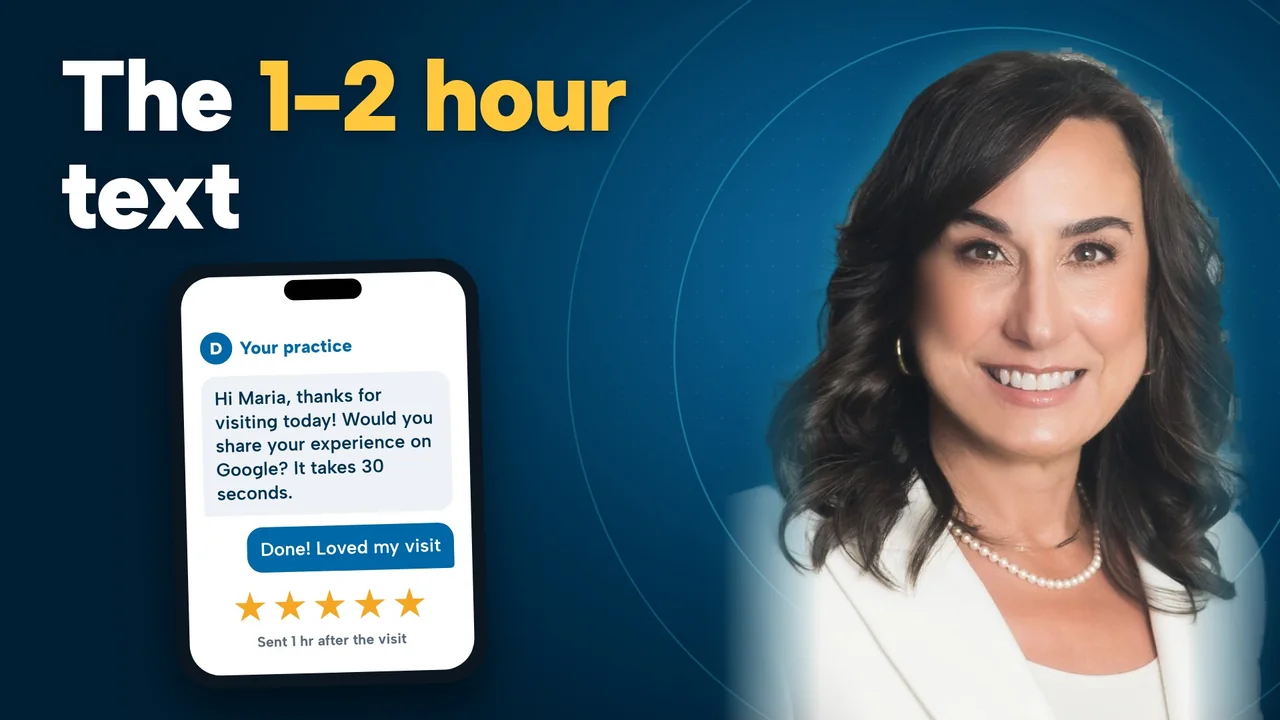
At the moment of delight in the chair, then by text 1 to 2 hours after the visit while the experience is still fresh. If there is no review after a few days, send one gentle reminder and stop. Do not ask the same patient again for about 6 months.
| When | What happens |
|---|---|
| In the chair | A verbal ask at the moment of delight |
| At checkout | Heads-up, confirm the mobile number, QR code on the desk |
| 1 to 2 hours later | Text with the direct review link (the sweet spot) |
| A few days later | One gentle reminder if there is no review yet |
| Then stop | More texts get you a STOP reply |
94% of people are open to writing a review if you catch them at the right moment. Watch the timing walkthrough.
What should your review request say?
Keep it short and personal. Use the patient's first name, include only one link (your direct Google review link), ask for honest feedback, and sign off with the doctor's name. Open with "How did everything go today?" and tell the patient the link is coming.
Scripts your team can use tomorrow, from the playbook slides:
Dentist: "I'm really happy with how this turned out. If you have a minute later, a Google review would mean a lot to our team. It helps people in town find a dentist they can trust."
Front desk: "We'll text you a quick link to leave a Google review. It takes about 30 seconds. Is this still the best mobile number for you?"
Want richer reviews that work harder in Google and AI? Do not script them; prompt them: "It would be great if you shared what you had done and how it made you feel." A review that names the treatment, the doctor and the feeling beats "Great dentist!" every time.
Get your Google review link and QR code
Sign in to your Google Business Profile, click "Ask for reviews" (sometimes "Get more reviews"), copy the short link and download the QR code. Test it, then put it everywhere: the checkout desk, the same-day text, the follow-up email, your website, staff email signatures and your social media bios. It takes about two minutes.
Is it better to get a lot of reviews at once or a steady flow?
A steady flow. Google, AI and patients all reward consistency and recency, so a burst in one month followed by silence looks dormant. A practice with fresh reviews from the last two weeks beats one with more reviews but nothing new in seven months.
The math is friendlier than most owners think. Twenty patients a day over 20 working days, with 10% leaving a review, is about 40 reviews a month. Even at 5%, that is 240 in a year. And recency matters: a quarter of people discount reviews that are three months old or older. See the consistency math in the video.
Make it automatic. When a visit is marked complete in your practice management system, your patient communication platform should send the review text on its own. Every completed visit gets the text, plus one reminder.
How should a dentist respond to reviews, including negative ones?
Respond to every review, good or bad, with the HIPAA-safe formula: thank them, reinforce your values (not their treatment) and invite them back or to contact you, signed with the practice name. For a negative review, pause, find out what happened, then reply publicly in a calm, short, general way and invite them to call you.
80% of people are more likely to choose a business that responds to all reviews, and generic copy-paste replies get discounted by patients and Google alike.
- Pause. Do not reply angry.
- Investigate. Find out what happened with your team.
- Reply publicly. Short, calm, HIPAA-safe. No details, no arguing.
- Take it offline. Invite them to call your office.
A safe reply to a one-star review about a long wait might read: "We're sorry to hear this. We work hard to respect everyone's time, and this isn't the experience we want for anyone. Please call our office so we can make it right." Watch the negative review section.
Track six numbers once a month: total reviews, new reviews per month, average rating, response rate, response time and days since the last review.
Where to start in the next 48 hours
- Grab your direct Google review link from your Google Business Profile, test it and share it with the team.
- Name your review champion.
- Turn on same-day review texts in your patient communication platform (ask your agency or support team if you cannot find the setting).
- Put a QR code at checkout.
- Reply to your last ten unanswered reviews, and make replying a habit.
If your reviews are in good shape but the phone still is not ringing, read why dental marketing is not working and how to get ChatGPT to recommend your dental practice. Want to see where your reviews stand against local competitors? Book a free strategy session and get your Practice Growth Package: a ranking report, an SEO visibility scan and an AI visibility analysis.
Want the slides? Download The Reviews Playbook for Dentists (PDF) with every script and template.
Frequently asked questions
How many Google reviews does a dentist need?
At least 20. Almost half of people will not use a business with fewer than 20 reviews. Beyond that, your local competitors set the target, so look at their review counts and steadily work past them.
When should a dental office send the review request text?
One to two hours after the visit, while the experience is fresh. If there is no review after a few days, send one gentle reminder and then stop.
Can a dental practice offer an incentive for reviews?
No. Google policy and the FTC rule both ban incentives such as discounts, gifts or drawings in exchange for reviews. You can, however, reward your own team for asking patients.
Can you mention treatment when replying to a review?
No. Never confirm someone is a patient, use their name or mention treatment in a public reply. Thank them, reinforce your values and invite them to contact the office.
How often can you ask the same patient for a review?
About every 6 months. Do not ask at every recall visit; six months or more between asks is a good rule.
Keep watching

Sonia Hounsell is Co-CEO of SERP Dental, a division of AscendPoint Agency. A brand marketer classically trained in healthcare at companies like Pfizer and Bayer, she launched an oral care product, took it to Shark Tank, and later sold the company.