

Yes, if the dental social media marketing agency runs your feed as a trust system, not a posting service. 77% of patients check a provider's social media before booking and 60% say it influences their choice. A good agency builds five content pillars, gets you on camera, runs it in 2 to 3 hours a week and reports inquiries, not likes.
Key takeaways
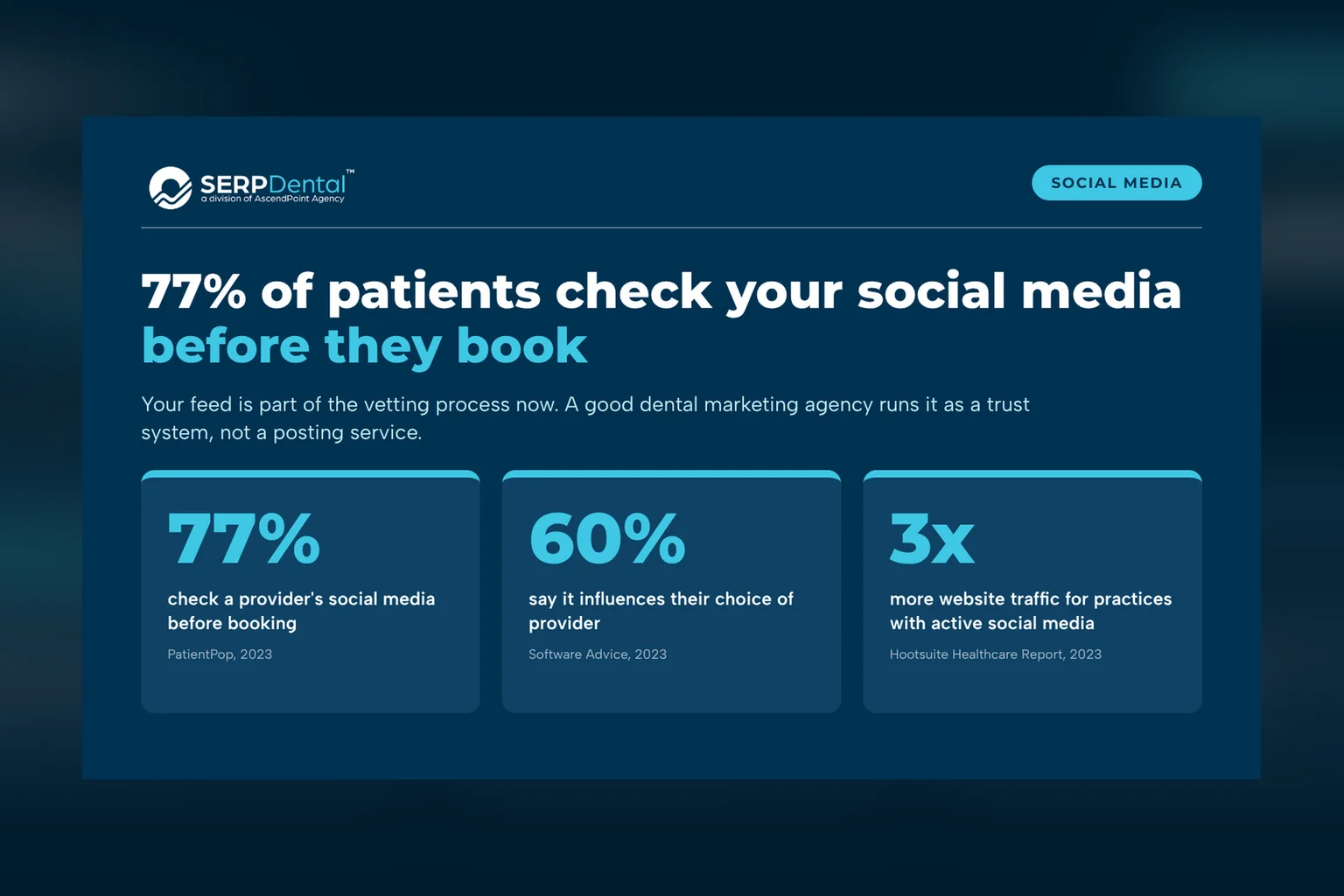
- 77% of patients check a provider's social media before booking and 60% say it influences their choice, so your feed is part of the vetting process.
- Every post should fall into one of five pillars: education 40%, transformation 30%, behind-the-scenes 15%, social proof 10% and engagement 5%.
- With AI doing 90% of the production, social media takes two to three hours a week in five short sessions.
- The dentist's job is not to run social media but to show up in it; an agency fits in the calendar, editing, scheduling and measurement.
- Pick two platforms and do them well before adding a third, and judge results by inquiries and booked appointments, not likes or followers.
Should your dental marketing agency run your social media?
Your feed gets checked twice before the phone rings, whether you post or not. 77% of patients check a provider's social media before booking; 60% say it influences their choice. So the question is not whether social media gets done, but who does it and what "done well" looks like.
Your patients are scrolling Instagram in your waiting room. If you are not in that feed, a competitor is.
The old patient journey had three steps: need a dentist, ask a friend, call and book. The new one has six: need a dentist, Google "dentist near me," check your social media, read your reviews, check your social media again, then maybe call. Your feed gets checked twice before the phone rings, whether you post or not.
The numbers back that up. 77% of patients check a provider's social media before booking; 60% say it influences their choice. Practices with active social media get 3x more website traffic. Before-and-afters earn 5 to 10x the engagement of text-only posts; video earns 12x.
So the question is not whether social media gets done, but who does it and what "done well" looks like. What follows is the standard I hold any dental social media marketing agency to, including mine, and it sits inside the broader test in What Is the Best Dental Marketing Agency? A Dentist's Guide to Judging Any Agency (Including Ours).
What should a dental practice post on social media?
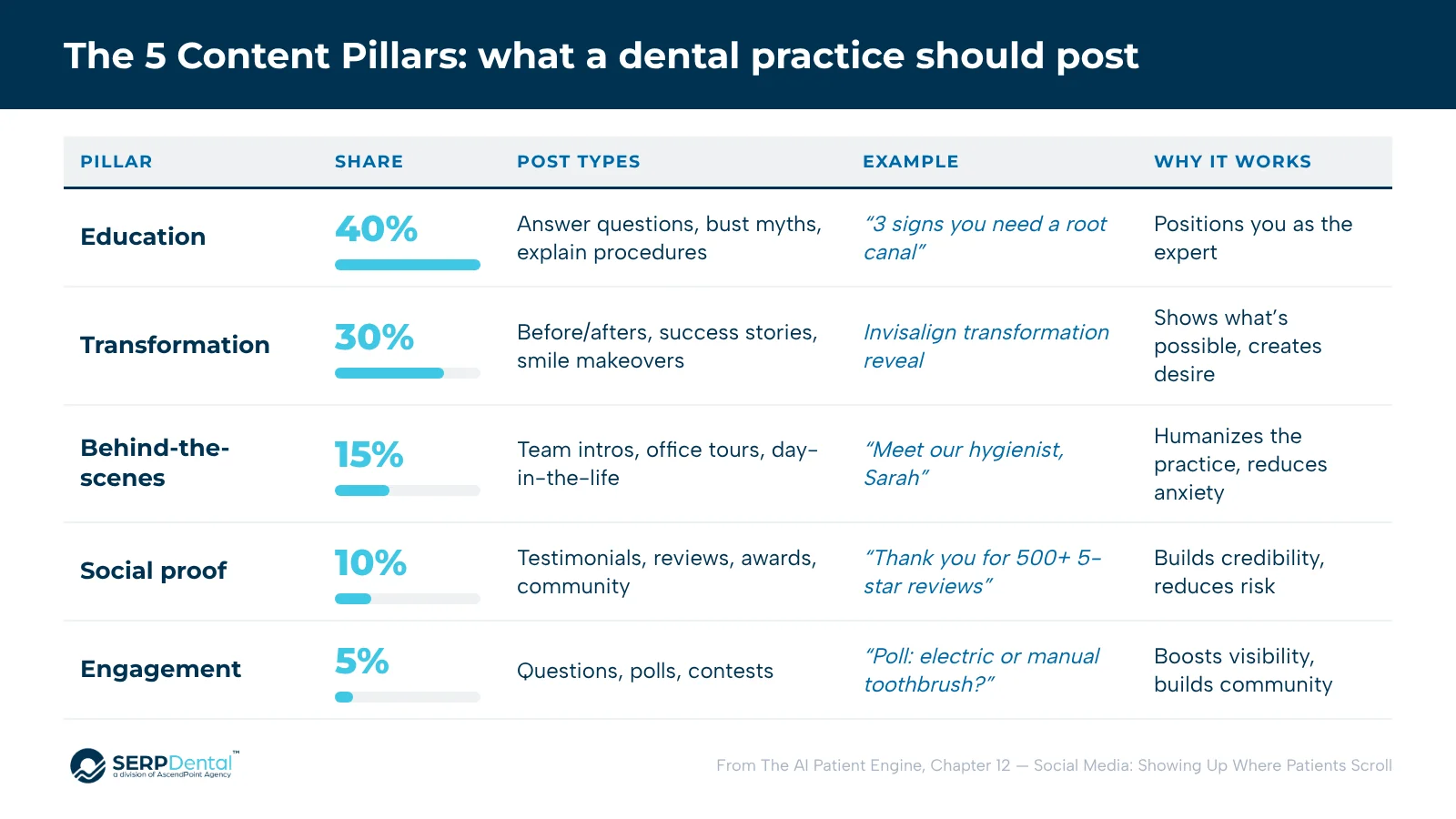
Patients have told us. 78% want before-and-after photos, 65% want educational content and 58% want behind-the-scenes team content. Every post falls into one of five pillars: education 40%, transformation 30%, behind-the-scenes 15%, social proof 10% and engagement 5%.
Patients have told us. 78% want before-and-after photos, 65% want educational content and 58% want behind-the-scenes team content. They do not want stock photos (fake), promotional posts (salesy) or an account that goes quiet after a month (abandoned).
My framework turns those preferences into a mix. Every post falls into one of five pillars:
- Education, 40% of posts: answer questions, bust myths, explain procedures. "3 signs you need a root canal." Positions you as the expert.
- Transformation, 30%: before-and-afters, success stories, smile makeovers. An Invisalign reveal. Shows what is possible and creates desire.
- Behind-the-scenes, 15%: team intros, office tours, a day in the life. "Meet our hygienist, Sarah." Humanizes the practice and lowers anxiety.
- Social proof, 10%: testimonials, reviews, awards, community. "Thank you for 500+ five-star reviews." Builds credibility and reduces risk.
- Engagement, 5%: questions, polls, contests. "Electric or manual toothbrush?" Feeds the algorithm and builds community.
If an agency's calendar is 60% offers, the mix is upside down. Patients scroll past selling and stop for teaching and proof. Every post draws from the same well as your service pages and blog, the engine in Should Your Dental Marketing Agency Write Your Content? The 6-Layer Content System That Feeds SEO, AI Search and Every Other Channel, and the social proof pillar runs on the review engine in How a Good Dental Marketing Agency Grows Your Google Reviews: The Review Engine That Feeds SEO and AI.
Why does most dental social media fail?
Most dental social media fails because of the old mindset: social media is for selling, post daily, get thousands of followers, count the likes. The new mindset flips each of those. Social media is for building trust, consistency beats frequency, quality followers beat quantity, and the score is patient inquiries, not vanity metrics.
I hear the same four objections: "I don't have time." "I don't know what to post." "I'm not comfortable on camera." "We tried it for a month and got nothing."
Each comes from the old mindset: social media is for selling, post daily, get thousands of followers, count the likes.
The new mindset flips each of those. Social media is for building trust. Consistency beats frequency. Quality followers, local people who could become patients, beat quantity. And the score is patient inquiries, not vanity metrics; likes and followers are not patients, as I argued in Why Most Dental Marketing Fails: The 3 Gaps That Tell You Your Agency Isn't Working. As I put it in The AI Patient Engine: "Social media isn't optional anymore. It's where your patients discover you, research you, and decide whether to trust you."
How much time should social media take?
Two to three hours a week, once AI does 90% of the production. Seven tools cover the production line, each for less per month than a crown, and the weekly workflow is five short sessions: plan topics, batch-record video and draft captions, design graphics, load the scheduler, then reply to comments and messages.
Two to three hours a week, once AI does 90% of the production.
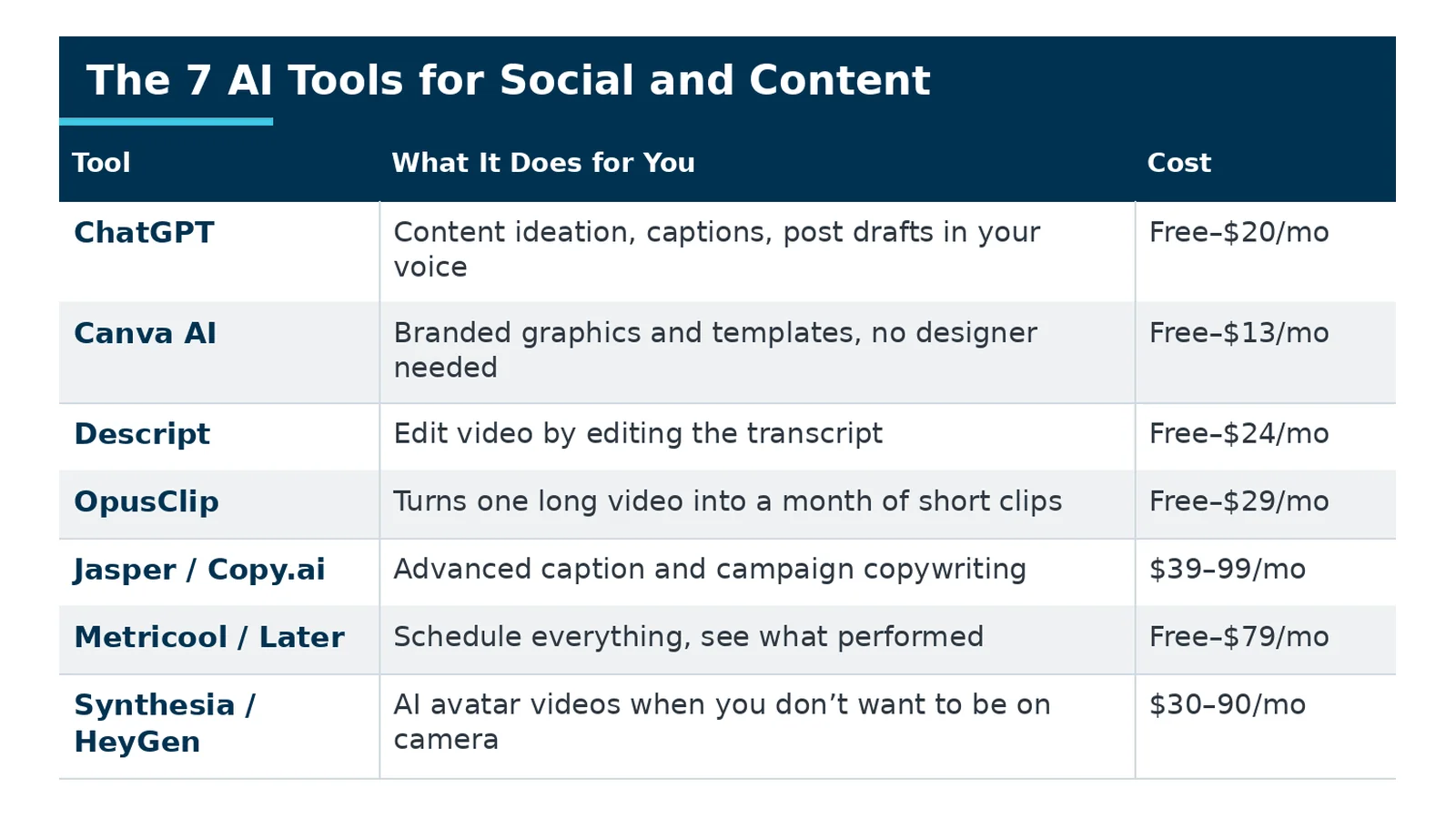
Seven tools cover the production line, each for less per month than a crown. ChatGPT drafts captions in your voice. Canva makes branded graphics without a designer. Descript edits video by editing the transcript. OpusClip turns one long video into a month of short clips. Jasper or Copy.ai handle heavier campaign copy. Metricool or Later schedule everything and show what performed. Synthesia or HeyGen make avatar videos when nobody wants to be on camera.
The weekly workflow is five short sessions:
- Monday, 30 minutes: pick topics from the five pillars.
- Tuesday, 60 minutes: batch-record video and draft captions with ChatGPT.
- Wednesday, 30 minutes: design graphics in Canva.
- Thursday, 30 minutes: load the scheduler.
- Friday, 10 minutes: reply to comments and messages.
Total: 2.5 to 3 hours.
I lay out the workflow, the tools and the pillar mix in The AI Patient Engine, publishing November 2026. None of it requires becoming an influencer; it requires a system.
Who should own it: your team, your dentist, or the agency?
The best in-house owner is a team member already comfortable on camera and active on these platforms. The dentist's job is not to run it but to show up in it. An agency fits in the parts that reward a system and a specialist: the calendar, editing, scheduling, measurement and the feedback loop into your other channels.
The best in-house owner is a team member already comfortable on camera and active on these platforms, often a younger hygienist or front-desk person. Give them the hours and a content calendar, and they will beat a stranger every time.
The dentist's job is not to run it but to show up in it. Practices where the doctor appears in even a quarter of the content dramatically outperform faceless accounts. A patient choosing an implant dentist wants to see that face.
Where does an agency fit? In the parts that reward a system and a specialist: the calendar, editing, scheduling, measurement and the feedback loop into your other channels. An agency that would run your social media without your footage and your face is selling you stock photos with your logo on them.
Which social media platforms matter for a dental practice?
Each platform has a job. Facebook is your local community and patients over 35, Instagram is visual proof, TikTok and Reels are discovery, YouTube is depth that feeds AI answers, and Google Business Profile posts are the sleeper. Pick two platforms and do them well before adding a third.
Each platform has a job. Facebook is where your local community and patients over 35 live; community stories, events and reviews work best, and local groups are gold. Instagram is visual proof: before-and-afters, team culture and Reels for reach. TikTok and Reels are discovery: short myth-busting video reaches people who never searched for you, and for younger patients TikTok is now the primary search engine. YouTube is depth; a procedure explainer works for years and feeds AI answers.
Google Business Profile posts are the sleeper: almost nobody posts there, and Google rewards the practices that do.
Pick two platforms and do them well before adding a third. That is Market Everywhere, the M in What Should a Dental Marketing Agency Actually Do for You? The 5-Part SMILE Checklist.
How a good dental social media marketing agency reports results
Ignore vanity metrics. Three numbers matter: profile visits and website clicks (people moving toward you); saves and shares (content worth keeping); and above all, leads and booked appointments attributed to social in your tracking system. That is the standard any dental social media marketing agency should meet.
Ignore vanity metrics. Three numbers matter: profile visits and website clicks (people moving toward you); saves and shares (content worth keeping); and above all, leads and booked appointments attributed to social in your tracking system.
At SERP Dental, that is the report I hold my own team to. We build the pillar mix with the practice, batch-record with the doctor monthly, run the weekly workflow on the AI tools above, and post to two platforms plus Google Business Profile. The monthly report shows profile visits, website clicks, saves, shares and the inquiries and booked appointments attributed to social. That is the standard any dental social media marketing agency should meet: not likes, not followers, inquiries.
Want to know whether your feed is building trust or just filling a calendar? Book a free strategy session. We will review your last 90 days of posts against the five pillars and show you where the inquiries should come from.
Frequently asked questions
Should a dentist hire a social media marketing agency?
Hire one if it runs social media as a trust system: a five-pillar content mix, your dentist on camera in at least a quarter of the posts, two platforms done well, and a monthly report of profile visits, saves, shares and inquiries attributed to social. If the proposal is stock photos, daily promotions and a follower count, keep your money.
What should a dental practice post on social media?
Follow the five pillars: education (40%) such as answering questions and busting myths, transformation (30%) such as before-and-afters, behind-the-scenes team content (15%), social proof (10%) such as reviews and testimonials, and engagement (5%) such as polls. Patients say they most want before-and-afters (78%), educational content (65%) and team content (58%).
How often should a dental practice post on social media?
Consistency matters more than frequency. You do not need to post every day; you need to keep posting in month six. The weekly workflow in The AI Patient Engine plans, records, designs, schedules and engages in five short sessions totalling 2.5 to 3 hours, which supports a steady cadence across two platforms without burning out your team.
Which social media platform is best for dentists?
Each platform has a job. Facebook reaches your local community and patients over 35. Instagram carries visual proof and Reels. TikTok and Reels drive discovery among people who never searched for you. YouTube gives depth that feeds AI answers. Google Business Profile posts are the sleeper almost nobody uses. Pick two and do them well before adding a third.
How do you measure the ROI of dental social media?
Ignore likes and followers. Track three numbers: profile visits and website clicks, which show people moving toward you; saves and shares, which show content worth keeping; and leads and booked appointments attributed to social in your call and form tracking. ROI is the production value of those booked patients against the hours and tools spent.
Sources
Keep reading
Patrick Hounsell is Co-CEO of SERP Dental, a division of AscendPoint Agency. His first job in digital marketing came before you could buy keywords on Google, and he went on to serve as CEO of a worldwide digital marketing firm. He has had a front row seat to search for more than 25 years.