

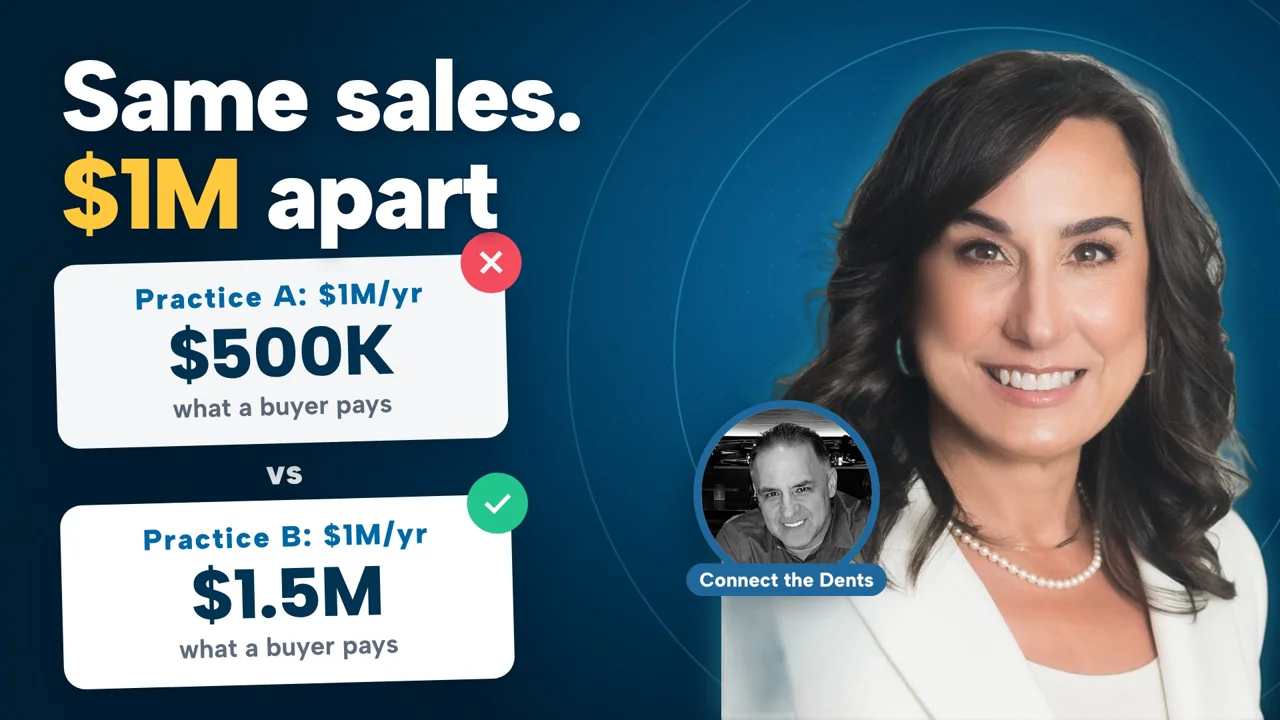
Two dental practices in the same zip code can both collect $1 million a year and be worth very different amounts. Dr. Tony Stefanou, who appraises practices and advises on dental mergers and acquisitions, sees $1 million practices valued at $500,000 and others at $1.5 million. One of the factors behind that gap in dental practice value is something many owners still treat as a cost: marketing.
For years the rule of thumb was that a practice is worth 80% of collections. Tony says that is no longer how buyers do the math. This guide explains how marketing increases dental practice value, how a marketing score shows up in an appraisal, and what buyers, including DSOs, want to see before they make an offer.
Tony and I walked through it together in the training below, using our Found, Booked, Valued framework: how patients find you, how easily they book, and how you prove the results to a buyer.
Video chapters (20)
- 0:00What you'll learn
- 2:29Meet Dr. Tony Stefanou
- 4:09Why 80% of collections is the old formula
- 6:53Meet Sonia Hounsell
- 11:12Found, Booked, Valued: the growth engine
- 14:04Found: patients now ask AI
- 16:08Why your Google Business Profile matters so much
- 18:20What is your practice known for?
- 20:10Reviews: the 4 star line
- 22:26Booked: the easiest practice to book wins
- 24:36Attribution: tie marketing to revenue
- 26:12Your PMS is a marketing asset
- 28:26Valued: what buyers pay for
- 30:03What raises risk for a buyer
- 31:03The growth flywheel
- 33:30The AI Growth Accelerator
- 34:26Q&A: how long until AI finds you?
- 36:53Q&A: marketing multiple locations
- 40:38How your marketing score moves practice value
- 45:26Why DSOs pay less without marketing
Key takeaways
- The old rule of 80% of collections is outdated: two $1M practices can be worth $500,000 or $1.5 million.
- In Tony Stefanou's example, raising a marketing score from 3 to 9 adds about $120,000 to a $1M practice.
- Buyers pay for repeatable, verifiable patient growth, not marketing spend. Attribution tied to your PMS is the proof.
- The easiest practice to book wins: online booking catches patients your phones miss and records where they came from.
- DSOs pay less for practices without working marketing systems, because they must invest more after the purchase.
Why aren't two $1M dental practices worth the same?
Because buyers no longer value a practice at a flat 80% of collections. They look at cash flow, put a multiple on it, and score the rest of the business: the collections trend, the hygiene department, operatories, technology, the lease, geography and marketing. Two $1M practices can land at $500,000 or $1.5 million.
Under the old formula, a practice collecting $1 million was worth about $800,000, and that was the end of the conversation. Tony says practice value is not determined that way anymore.
Today a buyer, whether that is another dentist, a group or a DSO, starts with cash flow (EBITDA) and a multiple. Then they weigh the intangible factors that separate one $1M practice from another.
What buyers look at beyond collections
| Factor | What a buyer asks |
|---|---|
| Collections trend | Is the practice trending up or trending down? |
| Hygiene department | How much of collections comes from hygiene? |
| Operatories and technology | How many operatories are there, and what technology is in place? |
| Lease | What does the lease look like? |
| Geography | Where is the practice, and what is that market like? |
| Marketing | How well branded and visible is the practice, and can it show where patients come from? |
Tony uses a practice score in his appraisals, and almost every buyer, especially the groups, has its own way of scoring a practice. Marketing is now one of the components.
That is good news for most owners. If your practice has been growing steadily and you have the pieces in place, Tony says you are very often worth more than the old percentage suggested. Watch Tony explain why 80% of collections is the old formula.
How does marketing increase dental practice value?
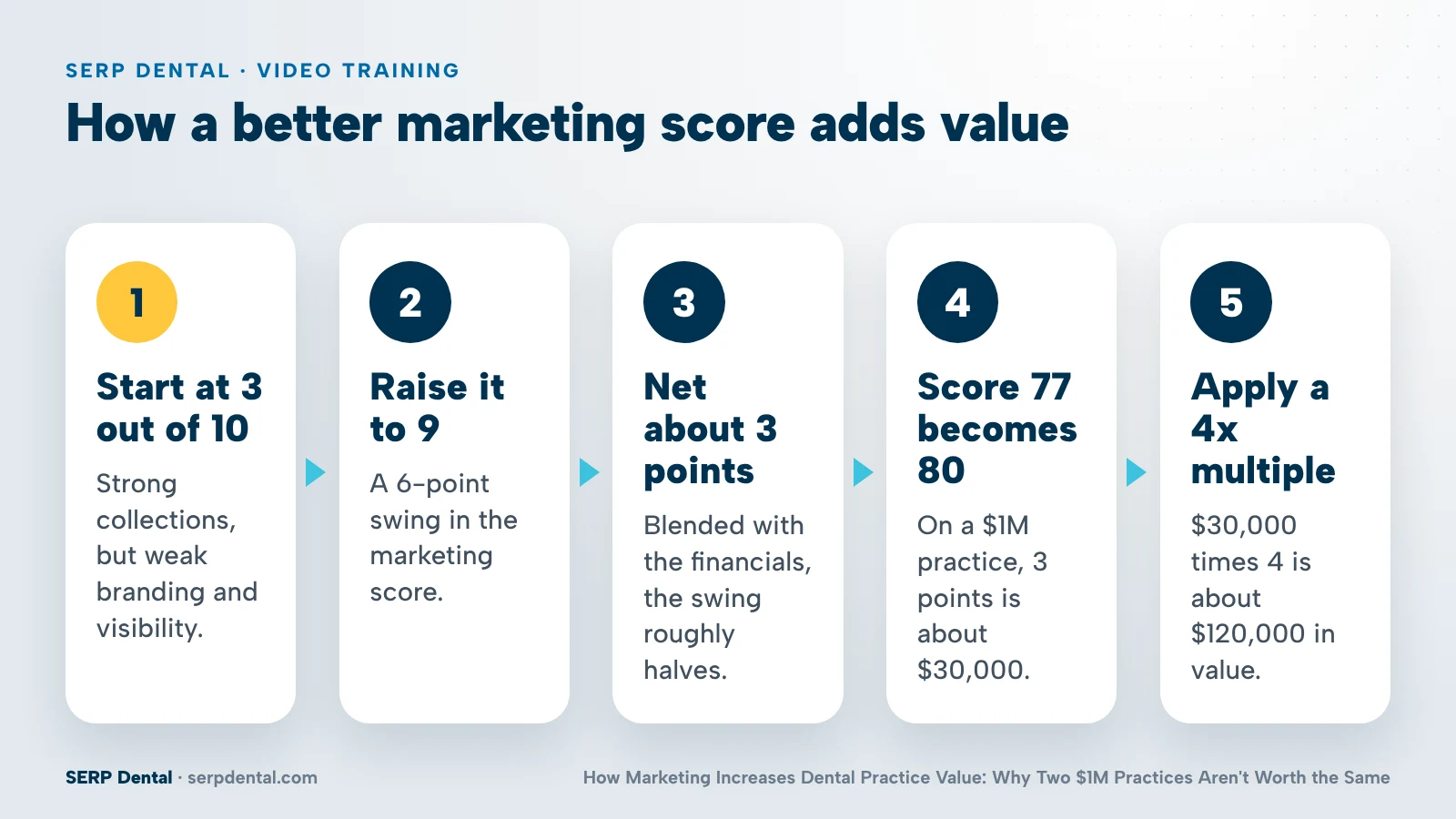
Marketing raises value two ways. Directly, a higher marketing score lifts the practice score in an appraisal. Indirectly, marketing grows hygiene and overall collections. In Tony's example, moving a marketing score from 3 to 9 adds about 3 net points to a $1M practice, worth about $120,000 at a 4x multiple.
When Tony appraises a practice, he uses our AI reporting to score its marketing on a 1 to 10 scale: how well branded the practice is, how visible it is, and how positive the things said about it are.
A practice can have strong collections and still score 3 out of 10 on marketing. The gap between a 3 and a 9 is where the money is.
Tony's marketing score math
| Step | The number |
|---|---|
| Marketing score today | 3 out of 10 |
| Marketing score after the work | 9 out of 10 |
| Swing in the marketing score | 6 points |
| Net effect once blended with the financials (roughly half) | About 3 points |
| Overall practice score | 77 becomes 80 |
| 3 points on a $1M practice | About $30,000 |
| Times a 4x multiple | About $120,000 in practice value |
The point Tony stresses is that value does not rise in a straight line. A few points on your score is not a few percent of your value, because the multiple compounds it.
The indirect lift
That $120,000 is only the direct effect. Marketing that works also increases hygiene and overall collections, which make you more profitable now, earn more points in the appraisal and can move you onto a higher multiple. The direct and indirect effects stack, and Tony says together they can swing hundreds of thousands of dollars in your favor. See Tony walk through the marketing score math.
What is the Found, Booked, Valued growth engine?
It is our system for taking a practice from prospect to profitability. Found is how patients and AI discover you, Booked is how easily that interest becomes an appointment, and Valued is how you prove the results to a buyer. Marketing and operations share ownership of all three, so neither can do it alone.
Years ago, marketing ran as a silo, bolted on. That no longer works: marketing now connects to operations, and that connection is what grows your return.
Search ads are a good example. Running them is the agency's job. But if the patients who click are not booked, those ads are not worth much to you.
| Pillar | What it covers | Who owns it | What a buyer sees |
|---|---|---|---|
| Found | AI answers, Google Business Profile, brand, reviews | Mostly marketing | A distinct, trusted brand |
| Booked | Online booking, answered calls, tracked sources | Marketing and the front desk | Interest that turns into appointments |
| Valued | Attribution, PMS reports, recall and treatment follow-up | Both, together | Repeatable, verifiable patient growth |
When the engine runs, you get new patients, more hygiene appointments and more treatment acceptance, which leads to production. Then come more reviews and referrals, which feed the front of the engine again.
How does being found by patients and AI affect practice value?
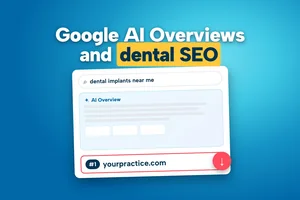
A practice that patients and AI engines cannot find has no steady flow of new patients to show a buyer. Last year, 17% of people used AI to find a dental practice. Now it is almost half. Your Google Business Profile, your reviews and a distinct brand decide whether you are the answer.
Adoption is fastest among a somewhat older population, a valuable group for the treatments dentists provide. When they ask AI for a dentist nearby who offers sedation, the answer depends on what your practice has put out there.
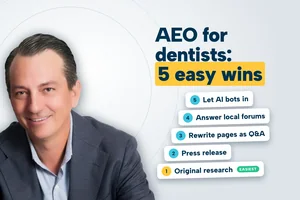
Your Google Business Profile now matters even more than your website. It is a trove of information AI can read, and it carries Google's authority. Your listings also need to match everywhere: if your name, address and phone number differ from site to site, it trips up AI. We cover the full list of fixes in how to get ChatGPT to recommend your dental practice and our guide to answer engine optimization for dentists.
Pass the known-for test
Your brand is not your logo. It is everything about your practice. Here is our one-liner test:
"We are the practice known for ________ in our market."
If you cannot fill in that blank clearly, your patients cannot either. When you can, and your message matches what you deliver, you become distinct. That distinctness is what helps AI pull you out of the sea of sameness, and a salient brand is part of what a buyer pays for.
Stay above the 4 star line
Reviews are the single most important thing driving your Google Business Profile. 70% of patients say they will not book a provider rated below 4 stars, and 75% will not consider anything under 4.5.
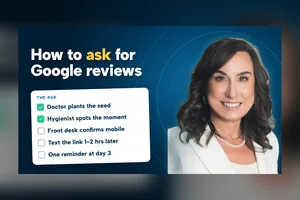
The basics: name a review champion, ask everyone, keep reviews coming steadily, and reply to every review without mentioning patient or treatment details. For the full routine, see how to ask patients for Google reviews.
Why does the easiest practice to book win?
Because patients book with whoever lets them book first. A patient in pain at 11 at night will not wait for your phones to open in the morning. Online booking captures that appointment, and it leaves a clean digital trail that shows exactly where the patient found you.
Picture the same patient on two paths. They need an emergency appointment late on a Monday night, and your practice comes up when they search.
| Moment | Phone only | Online booking |
|---|---|---|
| Late at night, in pain | Finds your website, cannot book | Finds you in AI search, taps your website, picks a time |
| Next morning | Calls and gets voicemail | Already has an appointment |
| Result | Books with another practice | Books with you |
If you only have a phone, you will miss patient opportunities. Every one of those patients is also missing from the documented flow a buyer wants to see.
You keep control of your schedule
The common worry is losing control of the schedule. Today's booking tools have settings for that. You can:
- Block any appointment type that should start with a conversation
- Block certain providers
- Block certain times
Online booking also makes attribution easy, because every booking is tracked.
What marketing proof do buyers want to see?
Buyers are not paying for your marketing. They are paying for repeatable, verifiable patient growth. That means a steady, documented flow of new patients, your cost per patient by channel, and attribution that ties each source to the patients who booked, showed up and produced revenue in your practice management system.
Attribution closes the loop. You spent money to find a patient and get them booked; attribution ties that spend to the revenue they brought in. Without it, nobody knows what is working, including a buyer. See what buyers pay for.
How to build the proof
- Turn on call tracking so every call from an ad or listing is tied to its source.
- Track every link that gets clicked, on your website, ads and profiles.
- Use online booking, which tracks itself.
- Set up the referral field in your PMS so every new patient has a source.
- Follow each patient through: booked, showed, and the revenue they delivered.
- Report cost per patient by channel and new patient production by channel.
For the setup details, see our dental lead tracking and analytics service.
Treat your PMS as a marketing asset
No marketing happens inside your PMS, but it tells you which marketing is working, and it shows who to bring back. Its opportunity reports surface unscheduled treatment, overdue hygiene and new patients who have not been booked.
Linking your PMS to your marketing turns treatment follow-up and hygiene reactivation into campaigns.
Put it on one dashboard
The practices we see do this best keep marketing and operations numbers side by side:
- New patients, by source, over time
- Calls answered from ads
- Booking rate
- Reactivation rate
When a buyer asks where your patients come from, this is the answer you point to.
What lowers dental practice value in a buyer's eyes?
Anything that makes future patient flow uncertain: weak recall, low treatment acceptance, not knowing where patients come from, no link between marketing and production, and a practice that leans on one doctor's reputation. Each one tells a buyer the growth may not repeat after the sale, and DSOs price that in.
| Risk | What a buyer worries about | What to fix |
|---|---|---|
| Weak recall | Hygiene revenue slipping away | Work your overdue hygiene report and reactivate |
| Low treatment acceptance | Production left on the table | Follow up unscheduled treatment and build trust |
| Unknown patient sources | Growth they cannot verify | Call tracking, tracked links, the PMS referral field |
| No link to production | Spend with no proven return | Tie each source to production |
| One-doctor dependence | Patients tied to one person | A brand and system that run without that person |
The last row surprises owners. Value comes from the whole system running well, not from one person in the room. A practice that runs well without a particular dentist is worth more, because it has longer-term value and more upside.
Why DSOs pay less without marketing in place
Tony is direct about this. A DSO will not tell you, but behind the scenes it will pay less for a practice that has no working marketing structures.
The DSO takes over the marketing after the purchase, so if yours is not working, it has to invest more once it owns the practice. That cost comes off your offer. If your systems are already in place and working, there is no extra investment to plan for, and the practice is valued higher. Hear Tony on how DSOs price marketing.
How does the growth flywheel compound practice value?
It starts with a strong culture, which builds a strong practice: staff stay, care is excellent, and more 5-star reviews follow. That creates a trusted brand and a loyal patient base, which makes your ads work harder, lifts treatment acceptance and makes each new patient cheaper over time.
Growth is not just systems and tools. It is a team mentality focused on what really works:
- Strong culture. The team is focused on growth and on what works.
- Strong practice. Staff stay, and the team delivers excellent care.
- Trusted brand. More 5-star reviews and better patient retention.
- Cheaper patients. When you run ads, you get more clicks, calls and bookings.
- Higher treatment acceptance. Acceptance is about trust. Patients who trust your brand say yes more often and do less price shopping.
- Room to grow. New services, more associates, new locations and easier recruiting.
We have seen practices we work with add associates and open new locations on the back of this growth, and AI compounds all of it.
Every turn of the flywheel adds to the documented, repeatable growth that buyers pay for. That is what it means to run a practice well today and get it valued well later.
Where to start this week
Start by measuring what a buyer would measure. Write your known-for line, test your own online booking late at night on your phone, turn on source tracking in your PMS, run your opportunity reports, and look honestly at how well branded and visible your practice is today.
- Write your known-for line. "We are the practice known for ________ in our market." Share it with your team and see if they agree.
- Book yourself an appointment at 11 at night. If you cannot, neither can a new patient.
- Turn on the referral field in your PMS. Make sure every new patient has a source.
- Run your opportunity reports. Pull unscheduled treatment and overdue hygiene, and start reactivation.
- Check your star rating. If you are under 4.5, put a review plan in place now.
Even if a sale is years away, each step makes the practice more profitable now and easier to value later. Want an outside view of where your marketing stands? Book a free strategy session and we will review your market, your AI and SEO visibility, your Google Ads and your technical setup, and leave you with a 6-month plan.
Frequently asked questions
How long does it take for marketing to show results in AI search?
It depends on the practice. An existing practice with some presence in its market moves faster: once we start working with a practice, we typically see results within the first 6 months, and certainly within 6 to 9 months. A brand new practice takes longer, because there is no authority built up online yet.
Should a dental group with several locations use one brand or separate brands?
There is no single right answer. Look at your goals, the history and authority each location already has, and the competition in each market. Do not throw away a location's strong reputation. Sometimes one location's positioning should be adopted by the others; sometimes unifying under one brand is better. A three-location practice we work with unified its branding because its markets were far enough apart.
Does marketing matter for practice value if I am not planning to sell for years?
Yes. Tony Stefanou notes that 80% of dental practice owners say their practice is their biggest asset, bigger than their real estate or other investments. Marketing that works raises collections and profitability now, and it builds the documented patient growth and marketing score that raise value whenever you do sell. The benefits compound over time.
Why is a dental practice worth more if it runs without the owner dentist?
Because a buyer is paying for future patient flow. If patients come for one doctor's reputation, some of that value can walk out the door after the sale. A practice whose brand, systems and team run well without a particular dentist in the room has longer-term value and more upside, so buyers will pay more for it.
Do buyers pay more because I spend a lot on marketing?
No. Buyers are not paying for the marketing itself. They are paying for repeatable, verifiable patient growth. Spend only helps your value when you can show where patients came from, what each one cost by channel, and the production they delivered, with attribution tied to your practice management system.
Keep watching
Sonia Hounsell is Co-CEO of SERP Dental, a division of AscendPoint Agency. A brand marketer classically trained in healthcare at companies like Pfizer and Bayer, she launched an oral care product, took it to Shark Tank, and later sold the company.